Senate Democrats unveiled a proposal Tuesday that would boost the pay
of essential workers on the frontlines of the battle against the
coronavirus pandemic by potentially tens of thousands of dollars.
As
much as $25,000 in hazard pay would be afforded over a period of time
to those deemed essential, including employees in health care, drug
stores, grocery stores, sanitation workers, truck drivers,
transportation workers and all federal employees with frontline
positions, such as Postal Service workers.
"Not all heroes wear
capes," Senate Minority Leader Chuck Schumer (D-N.Y.) told reporters on a
conference call Tuesday. "For these Americans, working from home is not
an option. Social distancing is not an option."
The raise would
be equivalent to $13 per hour and would apply retroactively from the
start of the health crisis emergency on January 27 until the end of the
year, Schumer said.
Health care workers also could receive a
one-time premium of up to $15,000 as part of a program to recruit and
retain certain medical employees in fields experiencing shortages. The
benefits would be applied retroactively for those already working on the
frontlines and to the families of health care workers who've died as a
result of coronavirus.
"We are asking these workers to take on
great risk. They should be compensated for it," Schumer said. "These
Americans are the true heroes of this pandemic, and we need to make sure
they are taken care of. They are there for us, so we must be there for
them."
Essential workers not part of the health care recruitment program who
earn less than $200,000 per year would receive a maximum premium pay of
$25,000 while those who make more than $200,000 would get a maximum of
$5,000. The extra pay would apply through December 31 or until the
worker's salary-based maximum premium pay is reached.
The federal
funds would be distributed to employers, who would need to apply for the
money for its employees. The federal agency that would be responsible
for distributing the resources is yet to be determined, Schumer said. A
total price tag for the package is also unknown.
The proposition
comes as Democrats in Congress are aggressively pushing for a fourth
stimulus package in the coming weeks to combat the sharp economic
downturn and increase in unemployment numbers.
The Heroes Fund
would need significant buy-in from Republicans. Schumer sidestepped a
question on whether he's spoken to his GOP counterpart, Majority Leader
Mitch McConnell (R-Ky.). McConnell's office did not respond to Newsweek's inquiry.
"We
hope that our Republican colleagues will join us in noting that this
Heroes Fund and hazard pay proposal is so very needed," Schumer said. "I
think it should get strong, bipartisan support."
Meanwhile, Democrats on the other side of the Capitol building in the House have changed course from advocating for a digital infrastructure-focused bill to pushing for an extension of the historic $2 trillion package recently passed, which would mean more individual checks, relief for small businesses and expanded unemployment benefits.
Tuesday, April 7, 2020


Sources on the Budget
The Committee for a Responsible Federal Budget, a bipartisan group of budget hawks, has some resources that may be helpful for your papers.
Our interactive tools are perfect for helping students to learn about the budget, Social Security, and the cost of proposed and enacted policies. These include:The Debt Fixer federal budget tool allows students to make many of the budget choices that policymakers face and see how those decisions affect the fiscal outlook. You can request dedicated links that allow you to easily see your students’ results by contacting debtfixer@crfb.org. Is It Worth With It, which allows students to break down the cost of proposed and enacted policies per person, taxpayer, and household. We have even included proposals from the 2020 presidential campaigns, and will continue to update throughout the election. Our Social Security Reformer tool allows students to dig deeper into this particular issue by providing numerous options to adjust Social Security revenues and benefits and see how those choices affect the program’s long-term solvency. While these tools have not yet been updated to reflect the fiscal and economic effects of the Coronavirus, they are still very useful for helping to teach about the country’s fiscal situation in general.
To learn more about the $2 trillion relief bill, the Coronavirus Aid, Relief, and Economic Security (CARES) Act, please check out our recent analysis. We also have an infographic, which is perfect for students, helping them visualize the various types of relief in the CARES Act, and where it is going.
Congress and Coronavirus
A very brief summary of the CARES Act: http://www.crfb.org/blogs/whats-2-trillion-coronavirus-relief-package (Yes, even in existential crisis, lawmakers cannot resist acronyms.)
Yuval Levin on Congress and crisis: https://www.aei.org/op-eds/the-crisis-congress
We just went through the budget process. So how can Congress suddenly spend trillions? The magic word is emergency. .https://thehill.com/opinion/finance/444455-federal-disaster-funding-doesnt-have-to-be-an-emergency
Don Wolfensberger on the procedural politics: https://thehill.com/blogs/congress-blog/politics/490106-procedural-politics-what-just-happened-with-the-coronavirus-bill
Proposals for a coronavirus commission -- a case study in crisis legislating: https://www.politico.com/news/2020/04/06/congress-coronavirus-commission-168195
Congress and the 1918 pandemic: https://govtrackinsider.com/what-did-congress-do-during-the-1918-flu-pandemic-c0bd96ad2287
A good example of a CBO cost estimate: the second (earlier) coronavirus bill: https://www.cbo.gov/system/files/2020-04/HR6201.pdf (Skim and sample: I do not expect you to have detailed knowledge of this document, but rather just want you to see what such estimates look like.)
Monday, April 6, 2020
Economic and Domestic Policy
POSSIBLE BILLS FOR SIMULATION:
https://www.congress.gov/bill/116th-congress/senate-bill/3302
https://www.congress.gov/bill/116th-congress/senate-bill/3440
Constitutional Provisions
All Bills for raising Revenue shall originate in the House of Representatives; but the Senate may propose or concur with amendments as on other Bills.”
— U.S. Constitution, Article I, section 7, clause 1
To raise and support Armies, but no Appropriation of Money to that Use shall be for a longer Term than two Years;
-- U.S. Constitution, Article I, section 8, clause 12
“No Money shall be drawn from the Treasury, but in Consequence of Appropriations made by Law; and a regular Statement and Account of the Receipts and Expenditures of all public Money shall be published from time to time.”
— U.S. Constitution, Article I, section 9, clause 7
What follows would baffle a Martian.
Authorization
Appropriation

Revenue Bills and RECONCILIATION (Straus ch. 5)
Revenues -- Where the money comes from:
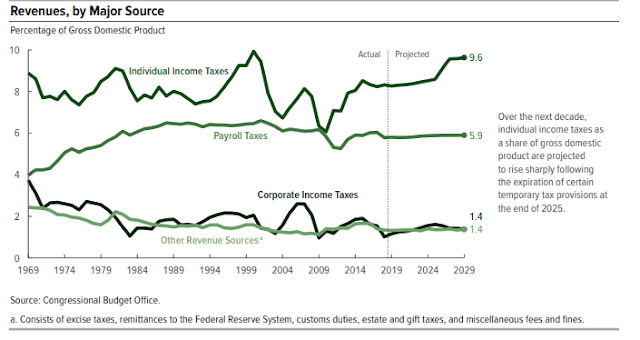
The tax system is more progressive than most people realize see esp. pages 11 and 18
Tax expenditures
Outlays -- Where the money goes:

Budget tables: function, subfunction, agency
No, we cannot balance the budget by catching Social Security fraud: only 13 people aged 112 or older are getting checks.
Deficit

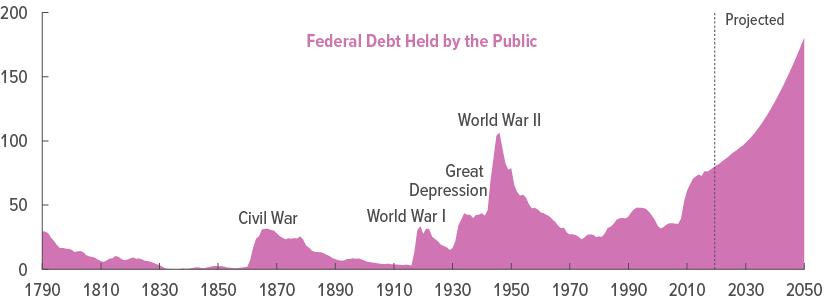
What happens if the US government defaults on the federal debt?
“No Money shall be drawn from the Treasury, but in Consequence of Appropriations made by Law; and a regular Statement and Account of the Receipts and Expenditures of all public Money shall be published from time to time.”
— U.S. Constitution, Article I, section 9, clause 7
What follows would baffle a Martian.
Authorization
Appropriation
- Budget Authority
- Outlay
- Continuing resolutions
- The 2018 omnibus -- what is it? Trump had to sign it to find out what was in it. And the Fox reaction freaked him out.
Revenue Bills and RECONCILIATION (Straus ch. 5)
Revenues -- Where the money comes from:

The tax system is more progressive than most people realize see esp. pages 11 and 18
Tax expenditures
Outlays -- Where the money goes:
No, we cannot balance the budget by catching Social Security fraud: only 13 people aged 112 or older are getting checks.
Deficit
What happens if the US government defaults on the federal debt?
Spending
Heather Caygle and Burgess Everett at Politico:Federal spending as a share of GDP this year is already closer to WWII levels than it is to the financial crisis, and that is only going to increase. There are big societal and policy changes to come. WWII resulted in the establishment of the Department of Defense. pic.twitter.com/qkNep7vVsp— Matt McDonald (@MattMcDHPS) April 4, 2020
Congress is finally beginning to sketch the outlines of its next big coronavirus response.
Speaker Nancy Pelosi shifted her tone on Friday, calling for a much more focused “Phase 4” relief package to address immediate needs related to the coronavirus pandemic, a departure from the sprawling legislation she and other top Democrats were pushing earlier this week.
The move puts Pelosi more on track to cut a deal with Republicans in the coming weeks, after numerous GOP officials panned her efforts to broaden the next phase of coronavirus legislation.
Both in a television appearance and talking with reporters Friday, Pelosi said it's clear the next tranche of relief funds should be an expansion of the massive $2 trillion package the president signed into law last week — more money to aid states, cities and small businesses, expand unemployment benefits and another round of direct cash payments for Americans.
...
Earlier this week, Pelosi and top House Democrats were making a very different pitch — saying now was the time to think big and take a broad brush approach to addressing the economic downturn, pushing ideas like a massive infrastructure package to help jumpstart the economy.Why the step back from infrastructure? People need help right now, not two or three years from now. Maybe congressional leaders remembered the Obama stimulus. In 2009, there was a great deal of talk about funding "shovel-ready" projects. After the stimulus passed, however, it soon became clear that massive public works projects are complicated, cumbersome, and far more time-consuming than officials had anticipated. CMC alum Michael Shear at The New York Times:
Even before President Obama entered the White House, he and his allies successfully used the allure of “shovel ready” infrastructure projects to help sell his $787 billion stimulus legislation to a resistant Congress and a wary public.
“I think we can get a lot of work done fast,” Mr. Obama, then the president-elect, said in December 2008, after meeting with governors. “All of them have projects that are shovel ready, that are going to require us to get the money out the door.”
But in a recent interview with Peter Baker for a cover story to be published Sunday in The New York Times Magazine, the president acknowledged what has become painfully obvious in last 20 months: “shovel ready” didn’t mean what he and most people thought it did.
Many of the road, bridge and sewer projects financed by the record-breaking spending bill took more than a year to even start construction as they got bogged down in bureaucratic red tape at the local level. For a country, and a president, eager to see jobs created quickly, the “shovel ready” part of the projects was a disappointment.
In his interview with Mr. Baker, the president said that the benefit of infrastructure spending was that for every dollar spent, “you get a dollar and a half in stimulus because there are ripple effects from building roads or bridges or sewer lines.”
“But the problem is,” he continued, “is that spending it out takes a long time, because there’s really nothing — there’s no such thing as shovel-ready projects.”
Sunday, April 5, 2020
Rocky Rollouts
Passing a bill is not enough to help people. Officials must implement it properly. Very often, implementation is the hard part.
Stephanie Ruhle and Ben Popken at NBC:
One day after the launch of a $350 billion loan program designed to rescue millions of small businesses pummeled by the coronavirus pandemic, technical glitches continued to cripple the ability of the nation's top lenders to begin processing the loans, throwing into doubt when any of the applicants will start receiving any money.
The lending program, which forms part of the $2 trillion Coronavirus Aid, Relief and Economic Security (CARES) Act, is a much-needed lifeline for the 30 million small businesses across the country. It offers loans of up to $10 million to companies who employ fewer than 500 people. Those loans are forgiven as long as the businesses meet certain conditions, such as using the majority of the funds to pay worker salaries for the eight weeks following the loan closing.
However, two of the nation's biggest banks say they have only just been able to start processing loans.
“We are all waiting on the Small Business Administration,” a Chase senior executive told NBC News.
In this respect, the CARES Act is far from unique. Obamacare also had a rocky rollout. On November 21, 2013, Roberta Rampton reported at Reuters:
In the last days before the botched October 1 launch of President Barack Obama’s healthcare website, the team in charge was seeing alarming results from performance tests, according to internal emails released by Republican lawmakers investigating the rollout.
HealthCare.gov was unable to consistently handle 500 users at once in the testing, and tests failed with 2,000 users over a three-day period, according to a series of emails between members of the information technology team at the Centers for Medicare and Medicaid Services, or CMS.
“I do not want a repeat of what happened near the end of December 2005 where Medicare.Gov had a meltdown,” Henry Chao, the website’s project manager at CMS, wrote in capital letters in an urgent message on September 26 to his team and contractors.
Chao was referring to the disastrous launch of the Medicare Part D prescription drug program under President George W. Bush’s administration. Technical woes prevented many seniors from initially gaining access to the website.
The emails, released by the Republican-led House Energy and Commerce Committee, are the latest to illustrate the depths of problems with the Obamacare website, which has frustrated millions of Americans with error messages and slow responses as they try to shop for health insurance.
The troubled rollout has been deeply embarrassing for Obama, who had promised up to the launch of the website that it would make shopping for plans as easy as buying televisions on Amazon.
It has also raised questions about the management of his signature healthcare reform program.The administration eventually fixed the problems, but by that time, public opinion had soured, thus contributing to GOP victories in the 2014 midterm.
Saturday, April 4, 2020
Inspectors General
In class this week, we briefly discussed inspectors general.
Maggie Haberman, Charlie Savage and Nicholas Fandos at The New York Times:
Maggie Haberman, Charlie Savage and Nicholas Fandos at The New York Times:
President Trump is firing the intelligence community inspector general whose insistence on telling lawmakers about a whistle-blower complaint about his dealings with Ukraine triggered impeachment proceedings last fall, the president told lawmakers in a letter late Friday.
The move came as Mr. Trump announced his intent to name a White House aide as the independent watchdog for $500 billion in corporate pandemic aid and notified Congress of other nominees to inspector general positions, including one that would effectively oust the newly named chairman of a panel to oversee how the government spends $2 trillion in coronavirus relief.
The slew of late-night announcements, coming as the world’s attention is gripped by the coronavirus pandemic, raised the specter of a White House power play over the community of inspectors general, independent officials whose mission is to root out waste, fraud and abuse within the government.
Mr. Trump is ousting the intelligence community inspector general, Michael K. Atkinson, because he lost confidence in him, the president wrote in a letter to leaders of the two congressional intelligence committees. He gave no further explanation.
Trump’s dead of night decision to fire ICIG Michael Atkinson is another blatant attempt to gut the independence of the Intelligence Community and retaliate against those who dare to expose presidential wrongdoing.
It puts our country and national security at even greater risk.


35.1K people are talking about this
The launch day of the highly touted $350 billion small-business loan program had a stuttering start Friday, from technical issues with bank websites to opaque lending rules that appear to qualify hedge funds to get aid, while some cash-strapped local businesses were shut out.
"I know there’s a lot of hard-working small businesses that couldn’t get their applications processed this week," Treasury Secretary Steven Mnuchin acknowledged in an interview on Fox Business on Friday afternoon. "They shouldn’t worry about it. There’s plenty of time, there’s plenty of money left."
“It’s been nothing short of a disaster. It’s been confusion at every turn,” said Grant Geiger, CEO of EIR Healthcare, which submitted a loan application Friday.
Geiger said he tried to apply via his company's primary lender, Wells Fargo, but was told the bank probably wouldn’t be ready to start accepting applications until Monday. The website he was directed to turned out to be little more than a shell.
Subscribe to:
Posts (Atom)