The Senate was set to take up a contentious vote on extending FISA, taking away valuable time from a response to the coronavirus outbreak. Sens. Mike Lee and Rand Paul were two of the bill's biggest obstacles: Mitch McConnell struck a deal with them to extend FISA in order to get a vote on coronavirus relief sooner. In return for moving up the coronavirus bill, McConnell will allow Lee and Paul to propose amendments to FISA when the bill returns to the floor, rather than filling up the amendment tree himself.
https://www.politico.com/news/2020/03/16/senate-short-term-extension-spy-programs-132401
Wednesday, March 18, 2020


DOD and Coronavirus response
https://www.defenseone.com/threats/2020/03/we-want-be-last-resort/163863/?oref=defenseone_today_nl
This is an interesting article on how the Department of Defense will give 1-5 million N95 masks to HHS and possibly setting up military combat hospitals. Secretary Esper does not serve on the coronavirus task force team and has been hesitant about the use of the military in the COVID-19 response.
This is an interesting article on how the Department of Defense will give 1-5 million N95 masks to HHS and possibly setting up military combat hospitals. Secretary Esper does not serve on the coronavirus task force team and has been hesitant about the use of the military in the COVID-19 response.
Congress News: Political Scientst Loses; Congress Ponders Stimulus; Mitch Seeks Judicial Vacancies
One of the last — and loudest — pro-life Democrats left in Congress lost his primary Tuesday night.Fun fact: Lipinski is a political scientist and Congress scholar (with a book on congressional communication).
Rep. Dan Lipinski (D-Ill.) lost to former advertising executive Marie Newman, trailing by 48%-44% with 90% of precincts reporting.
Newman came just short of beating Lipinski two years ago, with the backing of a broad coalition of progressive groups. This time, she jumped into the election early, and they lined up to boost her past Lipinski, outspending him by a wide margin. EMILY’s List, which backs pro-choice Democratic women, backed Newman early on, as did a plethora of other groups including NARAL Pro-Choice America, Planned Parenthood Action Fund, MoveOn, Indivisible, The Sierra Club, Service Employees International Union and Our Revolution.
John Bresnahan et al at Politico:
Senate Majority Leader Mitch McConnell said the Senate will work at "warp speed" to craft a massive new stimulus package to help Americans deal with the economic fallout from the coronavirus crisis, vowing that senators "will not leave" Washington until it's done.
And Senate Majority Whip John Thune (R-S.D.) said Tuesday there is a "high level of interest" among Republicans for a Trump administration proposal to send as many as two $1,000 checks directly to individual Americans to help respond to the economic slowdown, a move that could cost an estimated $500 billion, according to GOP sources.
Treasury Secretary Steven Mnuchin made a pitch for the initiative at a lunch with Senate Republicans on Tuesday, part of an $800 billion-plus package being floated by the White House that also includes as much as $250 billion in emergency loans for smalls businesses being hit by the economic slowdown.
Under the Mnuchin plan, direct payments — on a means-tested basis — could be sent to American via the IRS as early as next month, although even that may not be as fast as some in Congress want.
"I think there is a high level of interest among our members in that idea and seems it might be an area where there's some common ground with Democrats as well," Thune told reporters following the Republican lunch.
Sen. Josh Hawley (R-Mo.), who has proposed a similar plan, said Mnuchin told senators the administration "could stand that up pretty quickly ... and get pretty significant relief out there pretty fast."And on April 2, we shall discuss the interplay of Congress and the executive branch when it comes to staffing the judiciary.
Carl Hulse at The New York Times:
Running out of federal court vacancies to fill, Senate Republicans have been quietly making overtures to sitting Republican-nominated judges who are eligible to retire to urge them to step aside so they can be replaced while the party still holds the Senate and the White House.
Senator Mitch McConnell, Republican of Kentucky, who has used his position as majority leader to build a judicial confirmation juggernaut for President Trump over the past three years, has been personally reaching out to judges to sound them out on their plans and assure them that they would have a worthy successor if they gave up their seats soon, according to multiple people with knowledge of his actions.
...
Republicans have sent signals about judicial retirements in the past. In May 2018, with a midterm election looming that could have flipped the Senate, Senator Charles E. Grassley, Republican of Iowa and the chairman of the Judiciary Committee at the time, openly urged any Supreme Court justice pondering retirement to pull the trigger.
“If you are thinking about quitting this year, do it yesterday,” Mr. Grassley said during a radio interview. “If we have a Democrat Senate, you’re never going to get the kind of people that are strict constructionists.”
Justice Anthony M. Kennedy stepped down a little more than a month later and was replaced by Justice Kavanaugh, his former clerk.
Tuesday, March 17, 2020
Congress and Crisis
Melanie Zanona at Politico:
PHASE 3: PROFIT ... The Senate hasn’t even passed their second coronavirus package yet, and work is already underway on a third package to juice the economy. Some GOP lawmakers think they can pass legislation as soon as this week. It seems incredibly ambitious, but Sen. Marco Rubio (R-Fla.) raised this point: “I don’t think we can assume that we can keep reconvening the Senate every week like we did this week,” he told reporters. “With what might happen to airlines or travel schedules, with individual members having to go into quarantine or being exposed — I don’t think we can operate as if we can just bring the Senate and House back whenever we want.”
Senior administration officials met with several senators Monday and are planning to pitch the broader GOP conference on a third coronavirus relief bill today. Officials want to prop up small businesses, hotels and airlines, which are seeking a $60 billion bailout. “We’ll be looking for support for small and medium-sized businesses, we’ll be looking for support for certain industries that we’ve talked about that are particularly hard hit. I’ve talked about airlines, hotels, others. And we will be looking at a general stimulus,” Mnuchin told reporters, though he notably did not refer to the proposal as a “bailout.” Much more from Bres and Brianna Gurciullo: https://politi.co/39Sca6O.
Meanwhile, Senate Minority Leader Chuck Schumer (D-N.Y.) and other top Democrats are planning to unveil their own $750 billion-plus relief package today, while House Transportation Chairman Peter DeFazio (D-Ore.) warned his colleagues that the financial toll on airlines could be “worse than 9/11.” Trump and the GOP’s proposal may even top the Democrats’ price tag, with the administration preparing a rescue package of at least $800 billion, report Nancy Cook and Ben White, and it is likely to include a mix of industry aid and tax cuts. “I’m not going to comment on the specific numbers right now. … But it’s a big number,” Mnuchin told reporters last night. The dispatch: https://politi.co/3d6JoBm.
Related reads: “Support grows for sending every adult a $1,000 coronavirus check immediately,” via Susan Ferrechio of the Washington Examiner: https://washex.am/2vrdnmz; and “Casinos ask Congress for emergency aid as coronavirus toll sweeps industry,” by WaPo’s Jeff Stein, Rachel Siegel and Jonathan O’Connell: https://wapo.st/2Ql3YnK.
Monday, March 16, 2020
Problems with Remote Voting in Congress
At LegBranch.org, Joshua Huder acknowledges that the House might have to use remote voting in emergencies, but argues that it should not become routine.
Most proposals would limit remote voting to “noncontroversial” measures–basically, bills considered under “suspension of the rules,” a process requiring two-thirds passage (290 votes in the House). Many bills are noncontroversial. Congress renames a lot of post offices and regulates federal lands, among other bills of relatively minor significance. But even “noncontroversial” legislation can be a big deal. The “Doc-Fix,” which affected billions of dollars of healthcare spending, frequently passed under suspension of the rules. The second coronavirus assistance package, set to pass this week, is currently lined up on the suspension calendar. Suspension bills have retooled agencies’ prosecutorial authority, empowered inspectors general, and significantly changed how programs operate. Yes, the suspension calendar is primarily a vehicle for less controversial legislation, but not all non-controversial legislation is insignificant legislation.
Even worse, remote voting distances members from the policymaking process. Among the worst features of the current process is the gulf between rank-and-file members and the substance of legislating. Members are shut out of the floor amendment process. Leaders structure major agreements and present them take-it-or-leave-it packages. Omnibus legislation forces members to accept sometimes dozens of policy riders that would otherwise receive greater vetting if voted upon individually. Agencies receive less routine oversight and formal direction because regular but important reauthorizations fail to garner enough political or media attention. Agency spending bills escape scrutiny by passing en bloc rather than separately. If we want more individual member influence, putting distance between members and the process does the opposite. It gives leaders even more opportunity to legislate in secret, manipulate the process, and otherwise keep rank and file in the dark. For rank-and-file members to hold their congressional leaders accountable – whether committee chairs or party leaders – they need to, at a minimum, be physically present. “Remoting it in” has consequences.
Saturday, March 14, 2020
Congress in Emergency
This pretty accurate scene from Apollo 13 sums up what nearly everybody is doing right now:
We are making it up as we go along.
So it the real Congress.
Norman Ornstein at The Atlantic:
We are making it up as we go along.
So it the real Congress.
Norman Ornstein at The Atlantic:
There is no plan in place for Congress to hold remote meetings or otherwise conduct its business if it becomes impossible for its members to meet together, face to face in the Capitol or at another site in the District of Columbia. And that needs to change, right now.
...
Before Congress is forced to self-quarantine, it must act. First, Congress needs to pass a plan that allows for a virtual Congress, an idea originally proposed after 9/11 by Representative Jim Langevin of Rhode Island. And. at the same time, Congress needs to put into place the most sophisticated and secure remote-meeting software and hardware for its members. Every congressional committee and subcommittee needs to develop the same capacity, with the same authority. If members have to work from their district offices or even from home, they will need the ability not just to meet remotely, but to cast secure votes when necessary.
We also need, urgently, a plan to deal with the possibility that our election in November will be disrupted, if the pandemic makes voting at the polls difficult or dangerous. At a minimum, Congress should pass a law to allow no-excuse absentee balloting in every state for federal elections, while urging states that have no such requirement to do the same for state and local elections. And, ideally, we need a plan to deal with other possible election disruptions for which we have no options or workable alternatives in place. Leaving states to respond ad hoc is not a good way to deal with the many possible disruptions and dislocations. Senate Majority Leader Mitch McConnell could also help by upholding his patriotic duty and allowing quick votes on the many bipartisan plans to combat Russian or other foreign interference in our elections.In class this past week, we discussed how firsthand experiences affect the policy priorities of lawmakers. Jim Langevin has a special reason for his interest in congressional response to emergencies. Read here.
Wednesday, March 11, 2020
The Art of the Political Deal
- Acceptable sources of information.
- Repeated interactions
- Penalty defaults
- Privacy
Budget sequestration
Murray-Ryan: A summary
Coda: They pretty much gave up on deficit control
Crisis and Scandal as a Prod to Action
Sanders and McCain find a deal
Bernie Sanders and John McCain
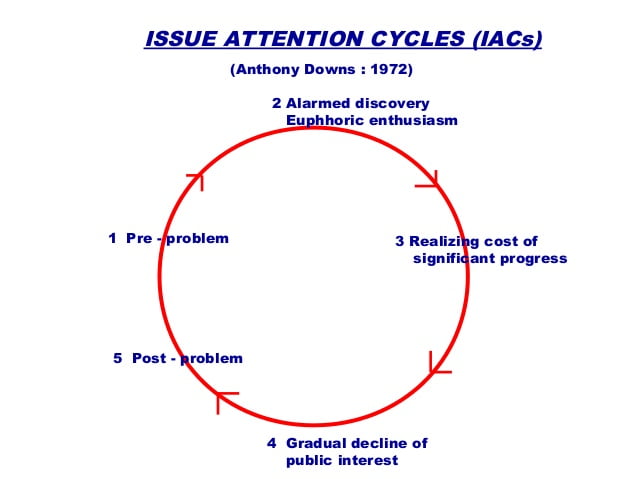
Policy Windows and The Issue-Attention Cycle
Public Lands Case Study

A couple of quotations about Congress and life in general:
- "At some point somebody has to decide, let's do it the old-fashioned way, which is `one thing I hate for one thing I love.'" (Lawrence, p. 39)
- "Here's a list of what we have to have. Here's a list of the ones we really, really hate. Here's a list of `if you put this language on page 4 we could swallow it.' And then you work that list." (Lawrence, pp. 40-41).
The 2014 farm bill and the "dairy cliff"
Subscribe to:
Posts (Atom)