ABOUT THIS BLOG

I shall post videos, graphs, news stories, and other material there. We shall use some of this material in class, and you may review the rest at your convenience. You will all receive invitations to post to the blog. (Please let me know if you do not get such an invitation.) I encourage you to use the blog in these ways:
To post questions or comments about the readings before we discuss them in class;
To follow up on class discussions with additional comments or questions.
To post relevant news items or videos.

There are only two major limitations: no coarse language, and no derogatory comments about people at the Claremont Colleges.


Search This Blog

Wednesday, February 28, 2018

The Art of the Political Deal II

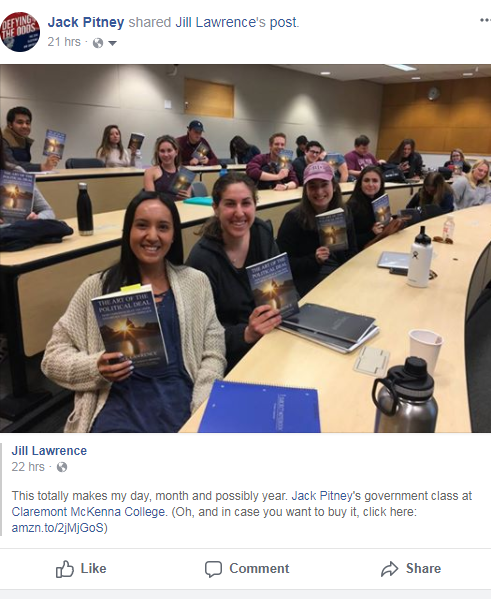
A Facebook post:


Politico Playbook offers an example of a discharge petition (Davidson, 238-240):
IN CASE YOU MISSED IT (YOU PROBABLY DID) … AS OF LAST NIGHT, 87 HOUSE DEMOCRATS have signed a discharge petition to try to force a vote on a bill that would “ensure that all individuals who should be prohibited from buying a firearm are listed in the National Instant Criminal Background Check System, and provide a responsible and consistent background check process.”
-- A DISCHARGE PETITION is really the only way the minority can pressure the majority to bring a bill to the floor. It needs another 129 signatures to make it to the floor -- that means Republicans need to sign on, as well. The signers http://bit.ly/2BU7U8L

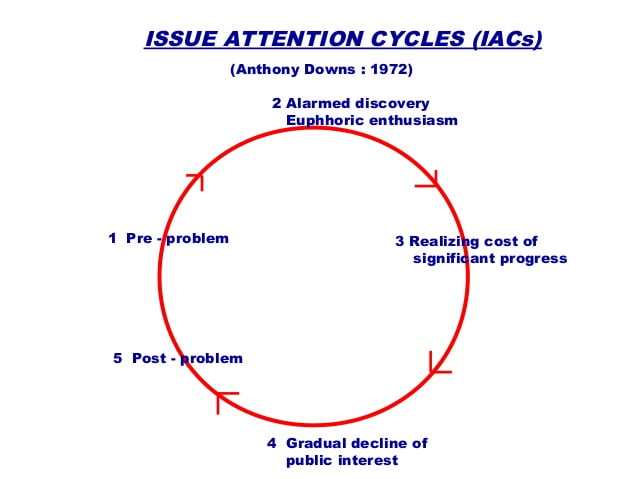
The Issue-Attention Cycle
Image result for issue attention cycle
Public Lands Case Study

Most public lands are in the West:

 Image result for public lands forests map
Policy Windows

A couple of quotations about Congress and life in general:

  • "At some point somebody has to decide, let's do it the old-fashioned way, which is `one thing I hate for one thing I love.'" (Lawrence, p. 39)
  • "Here's a list of what we have to have. Here's a list of the ones we really, really hate.  Here's a list of `if you put this language on page 4 we could swallow it.'  And then you work that list." (Lawrence, pp. 40-41).


Monday, February 26, 2018

The Art of the Political Deal

A reprise of our class anthem:


More on the sources of NRA's political strength.


Conditions for Deliberative Negotiation

  • First, participants must agree to acceptable sources of information. In some cases, the various sides rely on their own partisan facts; however, in other cases, the negotiation setting builds in an explicit role for nonpartisan third parties or technical expertise.
  • Second, a bargaining situation includes implicit decisions about patterns of interaction among participants; in particular, the decision to incorporate repeated interactions among parties may help to overcome myopia-inducing short-term and zero-sum calculations. The fear of each party that others will not cooperate (e.g., in the prisoner’s-dilemma game) creates incentives for short-term, self-interested choices. Bringing participants together in repeated engagements  facilitates future punishments for uncooperative behavior and, consequently, fosters trust and commitment.
    • Adam Smith was clear on the concept: "A dealer is afraid of losing his character and is scrupulous in observing every engagement. When a person makes perhaps twenty contracts in a day, he cannot gain so much by endeavouring to impose on his neighbour, as the very appearance of a cheat would make him lose. When people seldom deal with one another, we find that they are somewhat disposed to cheat, because they can gain more by a smart trick than they can lose by the injury which it does their character.
  • Third, decisions must be made about the consequences for nonaction in a negotiation process. Setting penalty defaults may move negotiators toward action, overcome blocking coalitions, and improve the chances for agreement 
  • Finally, decisions must be made about the degree of autonomy and privacy accorded to negotiators. In general, privacy boosts negotiators’ capacities to bargain effectively by producing some autonomy from influences that try to shift the focus away from the core objects of negotiation or that insist on hard-line positions opposed to compromise


Sanders and McCain find a deal

Bernie praises McCain

Friday, February 23, 2018

Sim Roles 2018


Armed Services Committee

Democrats
  • Jack Reed, RI, chair  Kai O'Neill
  • Kirsten Gillibrand, NY Sarah Malott
  • Tim Kaine, VA Talha Jilani
  • Elizabeth Warren, MA Ellie Wainstein
Republicans
  • John McCain, AZ, RMM Chloe Amarilla
  • Tom Cotton, AR Mickey McFall
  • Joni Ernst, IA Matthew May
Finance Committee

Democrats
  • Ron Wyden OR, chair Alec Lopata
  • Charles Schumer NY, majority leader* Julia McCarthy
  • Debbie Stabenow MI Skyler Addison [from the parties class]
  • Maria Cantwell WA Jacob Brady
  • Claire McCaskill MO Nick Sage
Republicans
  • Orrin Hatch UT, RMM Reid Dickerson
  • Mitch McConnell, KY, minority leader* Charlie Harris
  • John Cornyn, TX Mica Laber
  • Tim Scott, SC Kyleigh Mann
Judiciary Committee

Democrats
  • Dianne Feinstein, CA, chair Anna Green
  • Dick Durbin, IL Betzy Perez
  • Cory Booker, NJ McKenzie Deutsch
  • Kamala Harris, CA Becky Shane
Republicans
  • Chuck Grassley IA, RMM Jenna Lewinstein
  • Ted Cruz, TX Nicole Larson
  • Lindsey Graham, SC Gretta Richardson


Wednesday, February 21, 2018

Some thoughts of variable relevance

Most relevant: A case for optimism.
In chapter 2 of the Thurber book, I think it would be interesting for Binder to consider the increasing time constraints on elected officials, the increasing complexity of issues facing Congress, and Congressional productivity in terms of an absolute metric. She primarily examines the number of failed measures relative to the total number of issues on the legislative agenda.

I haven't taken the time to calculate the actual values, but from eye-balling figure 2.1b it appears that the number of legislative successes in salient issues decreased in the 1990s and then increased in the 2000s, peaking in the 110th Congress. Given the increasing complexity of issues, the increasing number of salient issues, and the increasing responsibilities of elected officials, I find this result somewhat hopeful. Figure 2.1a shows a modest decline in the overall number of successful pieces of legislation but this may be less meaningful because they are not all "salient" issues and because the increasing complexity of the issues facing Congress would generally lead to a decline in total legislative productivity.

Further- and this may be a bit to abstract- it might be worth considering that there may be a "maximum" productivity for Congress. Due to the time constrains imposed on legislators and the intentionally protracted legislative process, there may be a maximum number of high-quality, well researched, intelligently designed, and well written legislation that a congress can or should pass. Any additional measure over this theoretical maximum would have to either be of lower quality or be passed in some uniquely productive time period.
Just some thoughts.

Still relevant: Fun, or maybe not so fun, fact about the Filibuster.
Given the platitudes about the Senate being the chamber of "infinite debate," it surprised me to learn that the original Senate had a motion "for the previous question", essentially a cloture motion requiring only a simple majority of Senators to end debate. In 1806, it was removed from the Senate rules because it was so infrequently used. The authors of the paper titled the section, "The inadvertent Creation of the Opportunity to Filibuster".
http://www.law.harvard.edu/students/orgs/jlpp/Gold_Gupta_JLPP_article.pdf pages: 213-216

Tangentially relevant: It's not quite Congress, but it's local politics?
Some testimony that I saw from the L.A. City Council, not quite expert testimony, not celebrity testimony either... https://www.youtube.com/watch?v=tFUKsthR-Ts.
Decisionmaking II

Interest Groups


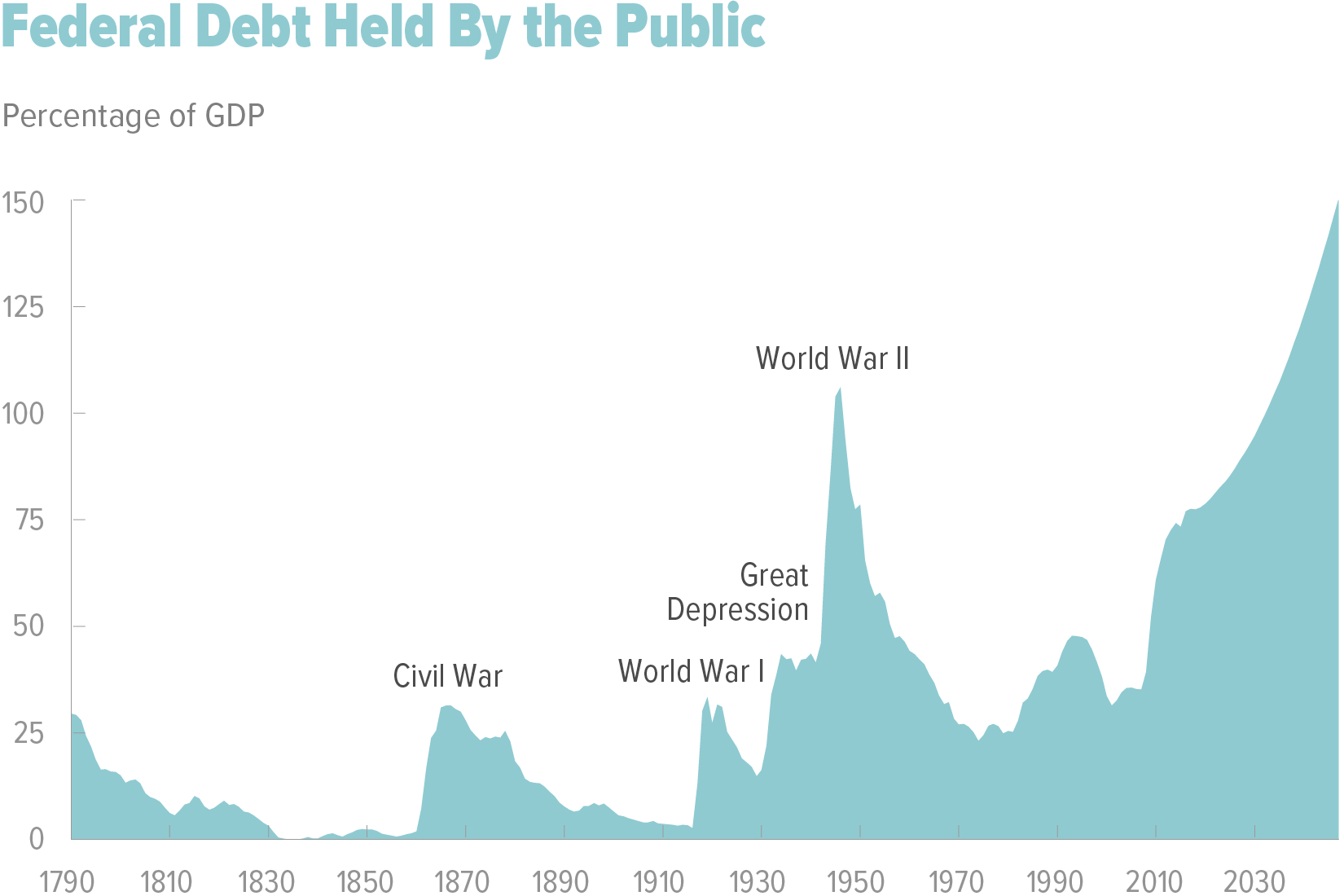
Slowing growth and rising debt mean more zero-sum issues


Debt projection before the tax cut:


Image result for cbo debt tax gdp


The GOP and Guns

Anna Palmer, Jake Sherman, and Daniel Lippman at Politico:
MANY REPUBLICANS FEEL LIKE THEY GO HOME to their safely red district and interact with constituents who are gun-toting NRA members -- many of whom show up to barbecues, fundraisers and political events carrying a weapon. Multiple Republicans told us they have held events at high-end shooting ranges. Gabe Debenedetti: “AR-15 auction removed from McMorris Rodgers fundraiser” http://politi.co/2GwJiSp
FORGET THE MONEY that the NRA gives -- it’s relatively inconsequential compared to other industries, and it’s a lazy explanation for the position that many Republicans hold. But many GOP voters exist in a media environment where they read the NRA’s magazines, pay attention to their scorecards come election time and wonder if the long arm of the U.S. government will come get their guns.
MOST REPUBLICANS exist in a climate in which their only political fear is a primary challenger on the right. To these Republicans, national polls mean squat. Getting on the “wrong side” of the gun issue would be going soft on guns -- that’s the way to lose a primary election. Few of these Republicans believe they’ll lose an election by not supporting stringent gun regulations.

CONSIDER THIS: In the House -- the more conservative of the two bodies -- 36 lawmakers sit in seats that elect Republicans by an average of 20 points or more. If you start looking wobbly there on any core issue -- which lawmakers say is immigration, abortion and gun rights -- you could be looking for a new job.
THEN THERE’S THEIR ARGUMENT that new gun laws wouldn’t do much. Ban assault weapons? Well there are plenty on the streets now. And if you ban assault weapons and someone shoots up a school with a pistol, then what’s next? Will the government move to make pistols illegal. How about tightening background checks? Many Republicans will tell you the laws in place now aren’t being enforced as they should be. Why add new regulations?
THERE IS A CLEAR SPLIT AMONG TOP REPUBLICANS WE TALK TO.Many believe this shooting is a tipping point. Others say, “eh.” Remember, Republicans didn’t do anything after one of their own — House Majority Whip Steve Scalise (R-La.) — was shot. And in 2011, they did nothing when Gabby Giffords -- then a member of the House -- was shot in the head meeting constituents outside a supermarket.

Monday, February 19, 2018

Decisionmaking in Congress

Switching sides on the filibuster and rules changes
 PFAW (at 17 minutes)
Reid 2005 and Reid 2013 and McConnell 2017
(See Davidson 255-56 and this post)


Polarization in the Public


Congressional Mitosis:


"CQ Vote Studies: Party Unity." CQ Magazine (February 12, 2018). http://library.cqpress.com.ccl.idm.oclc.org/cqweekly/weeklyreport115-000005263236 .


Interest group ratings


Blog Archive