ABOUT THIS BLOG

I shall post videos, graphs, news stories, and other material there. We shall use some of this material in class, and you may review the rest at your convenience. You will all receive invitations to post to the blog. (Please let me know if you do not get such an invitation.) I encourage you to use the blog in these ways:
To post questions or comments about the readings before we discuss them in class;
To follow up on class discussions with additional comments or questions.
To post relevant news items or videos.

There are only two major limitations: no coarse language, and no derogatory comments about people at the Claremont Colleges.


Search This Blog

Wednesday, May 1, 2019

Congressional History, Continued

Yes, the House can impeach a member of the cabinet.

More from Joanne Freeman:


The Compromise of 1850

Webster 1/26/1830:
 Let their last feeble and lingering glance rather behold the gorgeous ensign of the Republic, now known and honored throughout the earth, still full high advanced, its arms and trophies streaming in their original luster, not a stripe erased or polluted, nor a single star obscured, bearing for its motto no such miserable interrogatory as, “What is all this worth?” nor those other words of delusion and folly, “Liberty first and Union afterward”; but everywhere, spread all over in characters of living light, blazing on all its ample folds, as they float over the sea and over the land, and in every wind under the whole heavens, that other sentiment, dear to every true American heart—Liberty and Union, now and for ever, one and inseparable!
Daniel Webster, 3/7/1850 (during the South Carolina secession crisis):
I wish to speak to-day, not as a Massachusetts man, nor as a Northern man, but as an American, and a member of the Senate of the United States. It is fortunate that there is a Senate of the United States; a body not yet moved from its propriety, not lost to a just sense of its own dignity and its own high responsibilities, and a body to which the country looks, with confidence, for wise, moderate, patriotic, and healing counsels. 
Thomas Hart Benton and pistols in the Senate (Freeman 154-156)
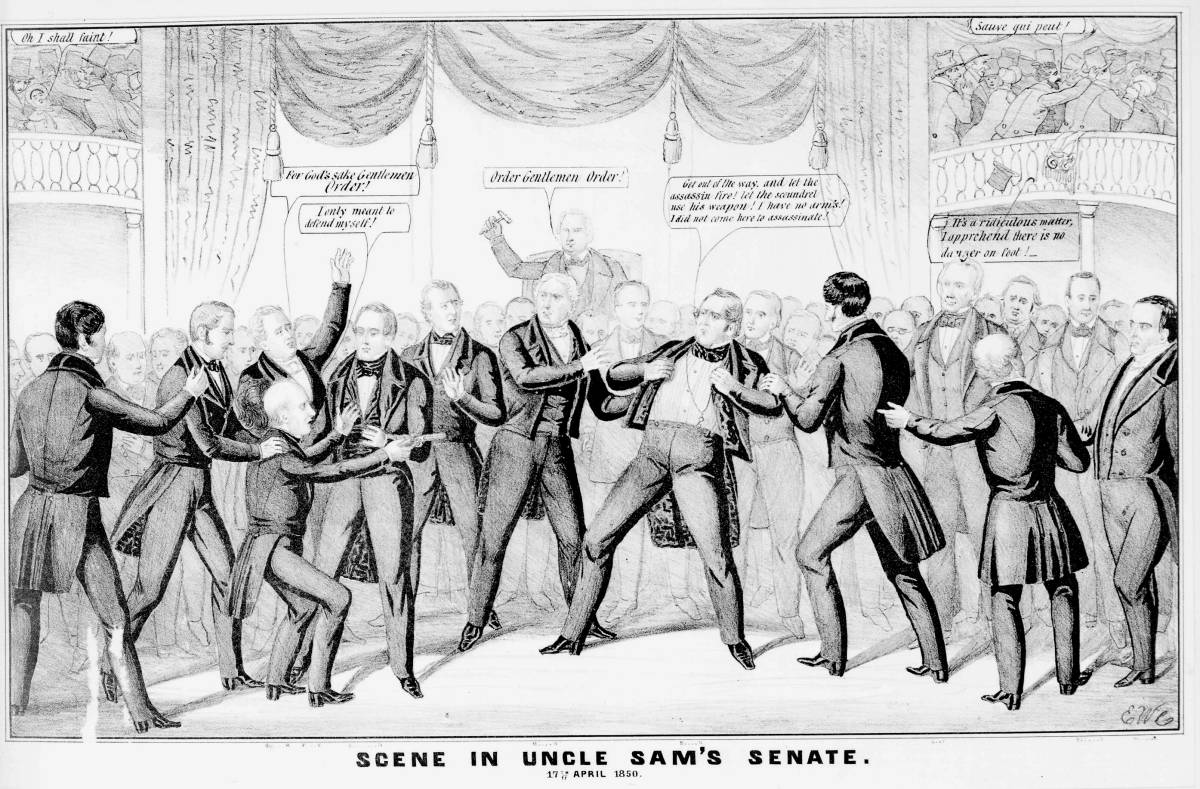


KANSAS-NEBRASKA


You want polarization? Here's some polarization. Representative Preston Brooks of South Carolina beats Senator Charles Sumner of Massachusetts

 .

Lincoln-Douglas debate (24:32)

Houston -- end of chapter 5 "I refuse to take this oath"

Congress and the Civil War

The Lincoln movie and parliamentary procedure


The Lincoln movie, more generally...

The congressional oath of office dates from this era.

Background on the impeachment process.

Andrew Johnson impeachment.

See the Tenth Article of Impeachment:
[Johnson did] make and deliver with a loud voice certain intemperate, inflammatory and scandalous harangues, and did therein utter loud threats and bitter menaces as well against Congress as the laws of the United States duly enacted thereby, amid the cries jeers and laughter of the multitudes then assembled and in hearing ... Which said utterances, declarations, threats, and harangues, highly censurable in any, are peculiarly indecent and unbecoming in the Chief Magistrate of the United States, by means whereof said Andrew Johnson has brought to high office of the President of the United States into contempt, ridicule, and disgrace, to the great scandal of all good citizens, whereby said Andrew Johnson, President of the United States, did commit, and was then and there guilty of a high misdemeanor in office.

Monday, April 29, 2019

Congressional History and the Field of Blood

"All of American history comes from the Civil War. It is the most important event in our history. Everything before it led up to it, everything since, everything, is a consequence of it." -- Ken Burns


From Article I, section 2

Representatives and direct Taxes shall be apportioned among the several States which may be included within this Union, according to their respective Numbers, which shall be determined by adding to the whole Number of free Persons, including those bound to Service for a Term of Years, and excluding Indians not taxed, three fifths of all other Persons.

Akhil Amar on the Three-Fifths Clause:
The radical vice of Article I as drafted and ratified was that it gave slaveholding regions extra clout in every election as far as the eye could see - a political gift that kept giving. And growing. Unconstrained by any explicit intrastate equality norm in Article I, and emboldened by the federal [3/5] ratio, many slave states in the antebellum era skewed their congressional-district maps in favor of slaveholding regions within the state. Thus the House not only leaned south, but also within coastal slave states bent east, toward tidewater plantations that grabbed more than their fair share of seats. ... The very foundation of the Constitution’s first branch was tilted and rotten.
And not just the first branch. The Article II electoral college sat atop the Article I base: The electors who picked the president would be apportioned according to the number of seats a state had in the House and Senate. In turn, presidents would nominate cabinet heads, Supreme Court justices, and other Article III judges.
Consequences of the Three-Fifths Clause.  From William Lee Miller, Arguing About Slavery:
Five of the first seven presidents were slaveholders [Washington, Jefferson, Madison, Monroe, Jackson], for thirty-two of the nation’s first thirty-six years forty of its first forty-eight, fifty of its first sixty four, the nation’s president was a slaveholder. The powerful office of Speaker of the House was held by a slaveholder for twenty-eight of the nation’s first thirty-five years. The president pro tem of the Senate was virtually always a slaveholder. The majority of the cabinet members and — very important — of justices of the Supreme Court were slaveholders. The slaveholding Chief Justice Roger Taney, appointed by slaveholding President Andrew Jackson to succeed the slaveholding John Marshall, would serve all the way through the decades before the war into the years of the Civil War itself; it would be a radical change of the kind slaveholders feared when in 1863, President Lincoln would appoint the anti-slavery politician Salmon P. Chase of Ohio to succeed Taney.


Adams


Territorial Expansion and Slavery

Calhoun denounces the "all men are created equal" line in the Declaration

Webster and Benton

The Field of Blood by Joanne Freeman (PO `84):

(start around 9:30)


Wednesday, April 24, 2019

Foreign Policy, Intelligence, and Political Courage

SJ Res 7 and Yemen

Federalist 70

Intelligence and Oversight: Hearings in the 1970s:
Treaties and International Agreements
  • Presidential power and Article II:" he shall receive Ambassadors and other public Ministers."
    • US v. Curtiss-Wright (1936): "It is important to bear in mind that we are here dealing not alone with an authority vested in the President by an exertion of legislative power, but with such an authority plus the very delicate, plenary and exclusive power of the President as the sole organ of the federal government in the field of international relations -- a power which does not require as a basis for its exercise an act of Congress but which, of course, like every other governmental power, must be exercised in subordination to the applicable provisions of the Constitution."
  • International Law and Agreements: Effect on US Law
    • Article VI:  "This Constitution, and the Laws of the United States which shall be made in Pursuance thereof; and all Treaties made, or which shall be made, under the Authority of the United States, shall be the supreme Law of the Land; and the Judges in every State shall be bound thereby, any Thing in the Constitution or Laws of any State to the Contrary notwithstanding."
  • Treaties (US Senate)
    • CRS on Reservations:   "After the Senate has begun considering this resolution, amendments proposing to change the text of the treaty itself are no longer in order. Senators may amend the resolution of ratification, however, by attaching to it reservations, declarations, statements, or understandings that can affect the interpretation or implementation of the treaty."
  • Executive agreements
  • The Iran deal was neither a treaty nor an executive agreement (and note the addressee)
  • Congressional-executive agreements
  • CONGRESS HAS DELEGATED A GREAT DEAL OF POWER TO POTUS
JFK on the complexity of courage:
  • The pressure to "go along" -- but we "should not be too hasty in condemning all compromise as bad morals."
  • The pressure to seek reelection -- but lawmakers "who go down to defeat in a vain defense of a single principle will not be on hand to fight for that or any other principle in the future."
  • The pressure to serve interest groups -- but "they are the articulate few whose views cannot be ignored and who constitute the greater part of our contacts with the public at large, whose opinions we cannot know..."

Monday, April 22, 2019

War, Intelligence, Foreign Policy

On January 12, 1991, House Speaker Tom Foley (D-WA) and Republican Leader Bob Michel (R-IL) spoke about the impending Gulf War. Click for video of their remarks, so you can see what grownups look like:

Miles's Law and the Syria Airstrikes

Prologue:  Steps in launching a nuclear war

Hamilton in Federalist 8: "It is of the nature of war to increase the executive at the expense of the legislative authority."

Tocqueville, p. 126: "If the Union’s existence were constantly menaced, and if its great interests were continually interwoven with those of other powerful nations, one would see the prestige of the executive growing, because of what was expected from it and of what it did."

The Constitution:

To declare war, grant letters of marque and reprisal, and make rules concerning captures on land and water;
 To raise and support armies, but no appropriation of money to that use shall be for a longer term than two years;
To provide and maintain a navy;
To make rules for the government and regulation of the land and naval forces;

To provide for calling forth the militia to execute the laws of the union, suppress insurrections and repel invasions;

To provide for organizing, arming, and disciplining, the militia, and for governing such part of them as may be employed in the service of the United States, reserving to the states respectively, the appointment of the officers, and the authority of training the militia according to the discipline prescribed by Congress;
Article II, section 2:
The President shall be commander in chief of the Army and Navy of the United States, and of the militia of the several states, when called into the actual service of the United States;
CRS explains that a declaration of war has enormous legal consequences
[A] declaration of war automatically brings into effect a number of statutes that confer special powers on the President and the Executive Branch, especially concerning measures that have domestic effect. A declaration, for instance, activates statutes that empower the President to interdict all trade with the enemy, order manufacturing plants to produce armaments and seize them if they refuse, control transportation systems in order to give the military priority use, and command communications systems to give priority to the military. A declaration triggers the Alien Enemy Act, which gives the President substantial discretionary authority over nationals of an enemy state who are in the United States. It activates special authorities to use electronic surveillance for purposes of gathering foreign intelligence information without a court order under the Foreign Intelligence Surveillance Act. It automatically extends enlistments in the armed forces until the end of the war, can make the Coast Guard part of the Navy, gives the President substantial discretion over the appointment and reappointment of commanders, and allows the military priority use of the natural resources on the public lands and the continental shelf. 
There have been 11 declarations of war.

Use of military force abroad (usually without a declaration of war)

The War Powers Resolution

Iraq

SJ Res 7 and Yemen


The Iraq War Resolution

Sunday, April 21, 2019

Final Essay, Spring 2019

Answer one of the following:
  1. Take any of JFK’s “profiles in courage.” How might a critic disagree with the analysis? How does this story illustrate differences and similarities between the Congress of its time and the Congress of today?
  2. Should Congress amend the War Powers Resolution?  If not, explain why current law is superior to its alternatives.  If so, explain what changes you would make.  In your answer, take account of military and political tradeoffs.
  3. In light of the Mueller report, should the House of Representatives launch an impeachment inquiry?  In your answer, examine the legal, factual, and political issues, and ponder the A. Johnson, Nixon and Clinton precedents. What are grounds for impeachment?  What are the potential risks and benefits to both parties?
  • Essays should be typed (12-point), double-spaced, and no more than four pages long. I will not read past the fourth page. 
  • Submit papers as Word documents, not pdfs.
  • Cite your sources. Use Turabian/Chicago endnotes. 
  • Watch your spelling, grammar, diction, and punctuation. Errors will count against you. Return essays to the Sakai dropbox by 11:59 PM, Wednesday, May 8. Papers will drop one gradepoint for one day’s lateness, a full letter grade after that.  

Wednesday, April 17, 2019

Domestic Policy

Distributive Politics

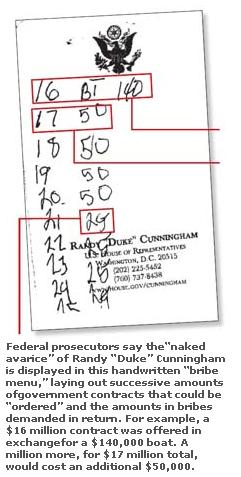
Earmarks and the Cunningham Bribe Menu (Davidson 405-407)


John Hudak at Brookings:
The removal of congressional earmarking does not make earmarking going away. It simply transfers that power and that practice from the legislative branch to the executive branch. Presidents—and their appointees—engage in pork-barrel politicking (earmarking) in the same way Congress does. Reforming the process in Congress by curtailing the practice of earmarking simply shifts that power more explicitly to a president and a cadre of unelected bureaucrats in government. Eliminating earmarking is a serious abdication of power by Congress which empowers a branch of government beyond what the Founders intended.
Regulatory Politics

Regulation and Its Cost (by CMC alum Richard Morrison)

Social Insurance (Theodore Marmor):
Social insurance, like commercial insurance, is about protection against financial risk. It is “insurance” in the sense that people contribute to a fund to protect themselves against unpredictable financial risks. These include outliving one’s savings in old age, the early death of a breadwinner, the onset of a disability that makes work difficult if not impossible, the high costs of acute illness, involuntary unemployment, and work-related injury. Yet unlike with commercial insurance, contributions are not prices in a market and thus do not depend on the contributor’s risk profile (unless commercial regulations say otherwise, in essence creating “social” insurance through the backdoor). Instead of a contract between an enrollee and an insurer, social insurance is a system of shared protection among the insured, most comparable to mutual insurance in the commercial realm, with contributions made in proportion to one’s market income. In social insurance, the “insurer”—whether a government agency or a corporate body with a joint labor-management board—is the agent of the contributing enrollees. And unlike commercial insurance, the social insurance “contract” mandates participation by law, since otherwise adverse selection would cause its unraveling.
Poverty Rate by Age

................18-64................65+

1959............17.0.............35.2
1969............08.7.............25.3
1979............10.9.............15.2
1989............10.2.............11.4
1999............10.1.............09.7
2009............12.9.............08.9
2017............11.2.............09.2

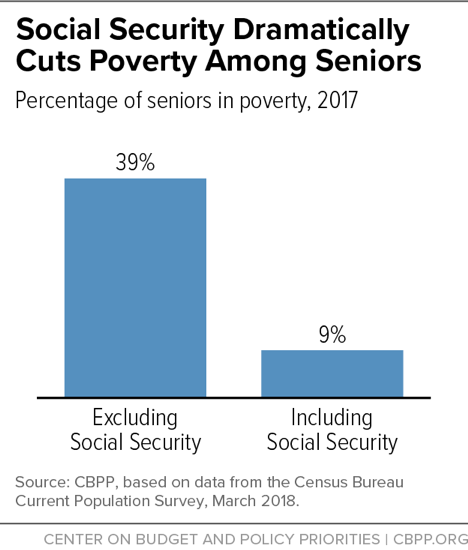
Credit Social Security for the decline in elder poverty

See how different the figures would be:

Social Security Dramatically Cuts Poverty Among Seniors


Image result for cost access quality health care


REVISITING A TOPIC FROM MARCH 6:


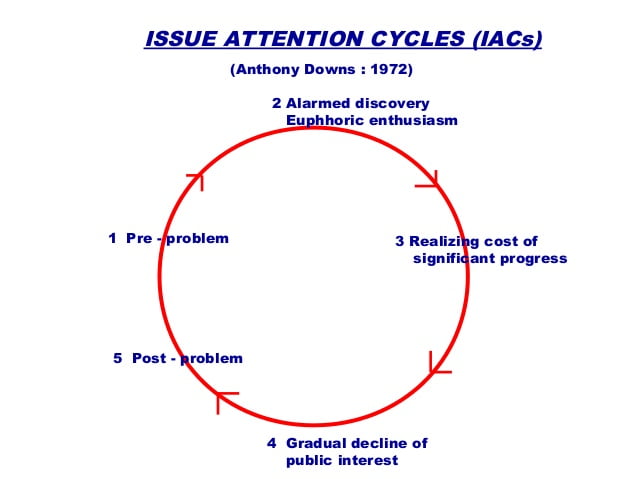
Policy Windows and  The Issue-Attention Cycle

Image result for issue-attention cycle

Monday, April 15, 2019

Pitzer alums and Congress!


Kara Eastman PZ '92, who was a social worker before entering the 2018 midterm race, is running for Congress again in 2020, presumably against incumbent Republican Rep. Don Bacon. In 2018, Eastman who ran on a platform that featured medicare-for-all was just two percentage points away from defeating Bacon in a Nebraska congressional district that voted for Trump.

Rep. Debbie Mucarsel-Powell (D-Fla.) PZ '93, CGU '96, also ran and won a very close race against incumbent Republican Carlos Curbelo.

Here is an article with more information about 7C alums who ran in the 2018 Congressional midterms.

Blog Archive