ABOUT THIS BLOG

I shall post videos, graphs, news stories, and other material there. We shall use some of this material in class, and you may review the rest at your convenience. You will all receive invitations to post to the blog. (Please let me know if you do not get such an invitation.) I encourage you to use the blog in these ways:
To post questions or comments about the readings before we discuss them in class;
To follow up on class discussions with additional comments or questions.
To post relevant news items or videos.

There are only two major limitations: no coarse language, and no derogatory comments about people at the Claremont Colleges.


Search This Blog

Saturday, January 26, 2019

EVERYTHING YOU NEED TO KNOW ABOUT LIFE IS IN "THE GODFATHER"

From Business Insider
The indictment said that in late 2017 Stone on "multiple occasions" told an associate, identified as "Person 2," that they "should do a 'Frank Pentangeli'" before the House Intelligence Committee "in order to avoid contradicting Stone's testimony." The filing goes on to say: "Frank Pentangeli is a character in the film 'The Godfather: Part II,' which both Stone and Person 2 had discussed, who testifies before a congressional committee and in that testimony claims not to know critical information that he does in fact know."
...
In "The Godfather: Part II," Pentangeli is called to testify before the Senate against Michael Corleone, the main character and mafia boss, but is ultimately dissuaded from doing so when Corleone brings Pentangeli's brother to the hearing all the way from Sicily — essentially to intimidate Pentangeli into not testifying against Corleone and to remind him of the code of silence he swore to uphold as a member of the mafia. Pentangeli then contradicts a sworn statement with damning allegations against Corleone and more or less tells senators that Corleone is not guilty of any wrongdoing.


Thursday, January 17, 2019

Monday, April 30, 2018

History III and The End

Congress and Progressive Reforms

16th Amendment
17th Amendment


Taft
Inherent limitations of Congress:
  • Except in simulation, legislation is slow. (And swift action is not necessarily smart action.)
  • In a body resting on geographic representation, parochialism is inevitable. (And it is often legitimate.)
  • A multi-member, bicameral institution will have a hard time planning.  (And planning is overrated.)

 Although the public good was the indirect beneficiary of his sacrifice, it was not that vague and general concept, but one or a combination of these pressures of self-love that pushed him along the course of action that resulted in the slings and arrows previously described. It is when the politician loves neither the public good nor himself, or when his love for himself is limited and is satisfied by the trappings of office, that the public interest is badly served.
... 
This is not to say that courageous politicians and the principles for which they speak out are always right. John Quincy Adams, it is said, should have realized that the Embargo would ruin New England but hardly irritate the British. Daniel Webster, according to his critics, fruitlessly appeased the slavery forces, Thomas Hart Benton was an unyielding and pompous egocentric, Sam Houston was cunning, changeable and unreliable. Edmund Ross, in the eyes of some, voted to uphold a man who had defied the Constitution and defied the Congress. Lucius Lamar failed to understand why the evils of planned inflation are sometimes preferable to the tragedies of uncontrolled depression. Nor-
ris and Taft, it is argued, were motivated more by blind isolationism than Constitutional principles.

Wednesday, April 25, 2018

Congressional HIstory II


The Compromise of 1850

Webster 1/26/1830:
 Let their last feeble and lingering glance rather behold the gorgeous ensign of the Republic, now known and honored throughout the earth, still full high advanced, its arms and trophies streaming in their original luster, not a stripe erased or polluted, nor a single star obscured, bearing for its motto no such miserable interrogatory as, “What is all this worth?” nor those other words of delusion and folly, “Liberty first and Union afterward”; but everywhere, spread all over in characters of living light, blazing on all its ample folds, as they float over the sea and over the land, and in every wind under the whole heavens, that other sentiment, dear to every true American heart—Liberty and Union, now and for ever, one and inseparable!
Daniel Webster, 3/7/1850 (during the South Carolina secession crisis):
I wish to speak to-day, not as a Massachusetts man, nor as a Northern man, but as an American, and a member of the Senate of the United States. It is fortunate that there is a Senate of the United States; a body not yet moved from its propriety, not lost to a just sense of its own dignity and its own high responsibilities, and a body to which the country looks, with confidence, for wise, moderate, patriotic, and healing counsels. 
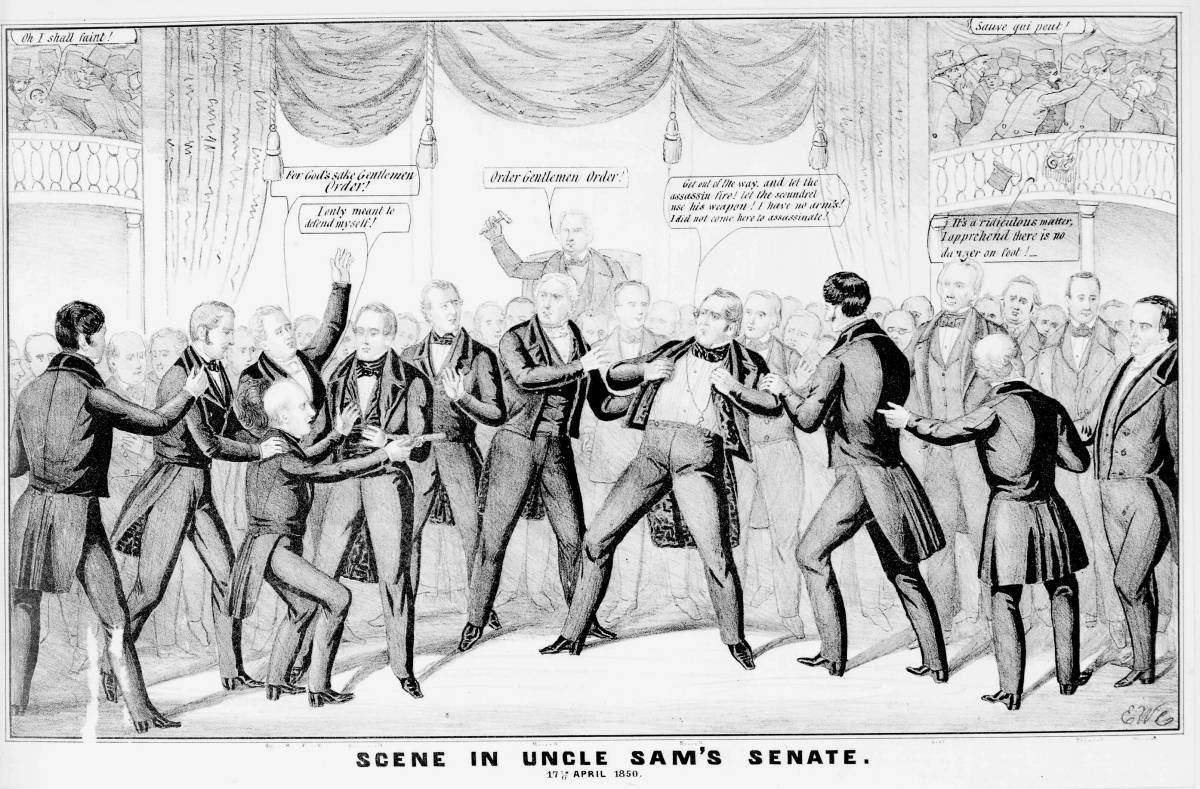
Thomas Hart Benton and pistols in the Senate


KANSAS-NEBRASKA


You want polarization? Here's some polarization. Representative Preston Brooks of South Carolina beats Senator Charles Sumner of Massachusetts

.

Lincoln-Douglas debate (24:32)

Houston -- end of chapter 5 "I refuse to take this oath"

Congress and the Civil War

The Lincoln movie and parliamentary procedure


The Lincoln movie, more generally...

The congressional oath of office dates from this era.

Background on the impeachment process.

There is an entire site on the Johnson impeachment.

See the Tenth Article of Impeachment:
[Johnson did] make and deliver with a loud voice certain intemperate, inflammatory and scandalous harangues, and did therein utter loud threats and bitter menaces as well against Congress as the laws of the United States duly enacted thereby, amid the cries jeers and laughter of the multitudes then assembled and in hearing ... Which said utterances, declarations, threats, and harangues, highly censurable in any, are peculiarly indecent and unbecoming in the Chief Magistrate of the United States, by means whereof said Andrew Johnson has brought to high office of the President of the United States into contempt, ridicule, and disgrace, to the great scandal of all good citizens, whereby said Andrew Johnson, President of the United States, did commit, and was then and there guilty of a high misdemeanor in office.

Another impeachment

Monday, April 23, 2018

Congressional History I

From Article I, section 2

Representatives and direct Taxes shall be apportioned among the several States which may be included within this Union, according to their respective Numbers, which shall be determined by adding to the whole Number of free Persons, including those bound to Service for a Term of Years, and excluding Indians not taxed, three fifths of all other Persons.

Akhil Amar on the Three-Fifths Clause:
The radical vice of Article I as drafted and ratified was that it gave slaveholding regions extra clout in every election as far as the eye could see - a political gift that kept giving. And growing. Unconstrained by any explicit intrastate equality norm in Article I, and emboldened by the federal [3/5] ratio, many slave states in the antebellum era skewed their congressional-district maps in favor of slaveholding regions within the state. Thus the House not only leaned south, but also within coastal slave states bent east, toward tidewater plantations that grabbed more than their fair share of seats. ... The very foundation of the Constitution’s first branch was tilted and rotten.
And not just the first branch. The Article II electoral college sat atop the Article I base: The electors who picked the president would be apportioned according to the number of seats a state had in the House and Senate. In turn, presidents would nominate cabinet heads, Supreme Court justices, and other Article III judges.
Consequences of the Three-Fifths Clause.  From William Lee Miller, Arguing About Slavery:
Five of the first seven presidents were slaveholders [Washingtonm, Jefferson, Madison, Monroe, Jackson], for thirty-two of the nation’s first thirty-six years forty of its first forty-eight, fifty of its first sixty four, the nation’s president was a slaveholder. The powerful office of Speaker of the House was held by a slaveholder for twenty-eight of the nation’s first thirty-five years. The president pro tem of the Senate was virtually always a slaveholder. The majority of the cabinet members and — very important — of justices of the Supreme Court were slaveholders. The slaveholding Chief Justice Roger Taney, appointed by slaveholding President Andrew Jackson to succeed the slaveholding John Marshall, would serve all the way through the decades before the war into the years of the Civil War itself; it would be a radical change of the kind slaveholders feared when in 1863, President Lincoln would appoint the anti-slavery politician Salmon P. Chase of Ohio to succeed Taney.


Adams


Territorial Expansion and Slavery

Calhoun denounces the "all men are created equal" line in the Declaration

Webster and Benton

"GOP split as banks take on gun industry"

I just read an interesting piece in Politico about how banks are taking on the gun industry in the wake of the Parkland shooting. In the past month, both Citigroup and Bank of America announced they would limit their business with gun manufacturers--especially those making military-grade weapons for the civilian market. The banks cited frustration over legislative inaction as one of their motives for supporting gun control.

Republicans disagree over how to treat the banks' new restrictions; some believe the government must respect the free-market and thus the decisions of a private business, while others argue that banks should not take a political stance on such a contentious topic. In an interview, Sen. John Kennedy said, "Frankly, [the banks] ought to stay out of Congress' politics. That's our job to legislate with respect to the Second Amendment, and the United States Supreme Court's job to interpret the Constitution. I would be offended by it if they came out in support of the Second Amendment. If they want to be involved in politics, the CEO ought to quit and run for Congress."

I think it is interesting how private institutions can influence policy through their own business practices. With increased gridlock and a Congress that does not effectively check the president, I am curious to see what new political tactics private corporations will use over the next several years. If this article is any indication, we can expect to see corporations strengthen their political stances with concrete business policies.

Blog Archive