ABOUT THIS BLOG

I shall post videos, graphs, news stories, and other material there. We shall use some of this material in class, and you may review the rest at your convenience. You will all receive invitations to post to the blog. (Please let me know if you do not get such an invitation.) I encourage you to use the blog in these ways:
To post questions or comments about the readings before we discuss them in class;
To follow up on class discussions with additional comments or questions.
To post relevant news items or videos.

There are only two major limitations: no coarse language, and no derogatory comments about people at the Claremont Colleges.


Search This Blog

Sunday, February 1, 2026

First Assignment, Spring 2026

Answer one of the following two options:

Option 1

Chapter 3 of the Davidson book begins with a short vignette about Rep. Derek Tran to introduce its core themes of ambition and recruitment. Write a replacement opening vignette featuring a different House member who won a first term in the 2024 electionIn your vignette:

  • Identify one specific decision point in this member’s path to office (e.g., whether and when to run at all, which seat to pursue).
  • Tell why you chose this particular member, and how this case highlights something that Tran’s vignette does not.
  • Analyze how this member’s experience illustrates or complicates arguments in the sections “Becoming a Candidate” and “Nominating Politics,” citing at least two specific passages from the book. This part is most important.
  • Briefly note one fact or episode you encountered in your research that would not typically appear in a textbook vignette but sheds light on this member’s recruitment or nomination. 
Do not simply summarize the member’s biography or election results. Your job is to write something the authors could plausibly adopt, and to explain why.


Option 2

Choose one current congressional leader (Johnson, Jeffries, Thune, or Schumer) and write a postscript to Chapter 6 of the Davidson book. Your postscript should:
  • Identify one specific moment since January 2025 when this leader faced a choice that tested party unity, procedural control, or bargaining leverage.
  • Quote and cite at least two specific passages from the chapter that are most relevant to that moment.
  • Explain how the leader’s behavior confirms, complicates, or contradicts the theory of conditional party government.  This part is most important.
Use at least three primary sources (e.g., floor statements, press releases, leadership letters, official transcripts).  In a short concluding paragraph, quote one sentence from Chapter 6 that the authors might revise if they were writing the next edition. Justify your choice.

Essays should reflect an understanding of class readings and discussions. Many resources, including CQ Magazine are at Library/Databases/CQ Library.  You must consult other sources as well. See, among others: 

Read Strunk & White and my stylesheet (with links to model papers).

The specifications:
  • Essays should be typed (12-point), double-spaced, and no more than three pages long. I will not read past the third page. 
  • Please submit all papers in this course as Word documents, not Google docs or pdfs.
  • Cite your sources. Please use endnotes in the format of Chicago Manual of Style.  Endnotes do not count against the page limit. Please do not use footnotes, which take up too much page space.
  • Misrepresenting AI-generated content as your own work is plagiarism and will result in severe consequences
  • Watch your spelling, grammar, diction, and punctuation. Errors will count against you. Return essays to the Canvas dropbox for this class by 11:59 PM, Friday, February 13. (If you have trouble with Canvas, simply email me the paper as an attached file.)  I reserve the right to dock papers one gradepoint for one day’s lateness, a full letter grade after that.

Tuesday, January 27, 2026

Congressional History

 For next Monday, Davidson, ch. 3 and 4.

If you have not already done a writeup: Find one sentence in Chapter 2 you disagreed with. Quote it and explain why it does not fit how you think members of Congress actually behave today.  If you cannot find one with which you disagree, find one that an ideologue of the left or right would dispute.

Institutional Evolution:

  • Bicameralism and House-Senate differences: impact of 17th Amendment.
  • Size of the House and Senate (more below)
  • Congressional Career and professionalism
    • Staff
    • Rules and Institutional Structure

"All of American history comes from the Civil War. It is the most important event in our history. Everything before it led up to it, everything since, everything, is a consequence of it." -- Ken Burns

"The past is never dead. It's not even past." -- William Faulkner

Akhil Amar on the Three-Fifths Clause:

The radical vice of Article I as drafted and ratified was that it gave slaveholding regions extra clout in every election as far as the eye could see - a political gift that kept giving. And growing. Unconstrained by any explicit intrastate equality norm in Article I, and emboldened by the federal [3/5] ratio, many slave states in the antebellum era skewed their congressional-district maps in favor of slaveholding regions within the state. Thus the House not only leaned south, but also within coastal slave states bent east, toward tidewater plantations that grabbed more than their fair share of seats. ... The very foundation of the Constitution’s first branch was tilted and rotten.
And not just the first branch. The Article II electoral college sat atop the Article I base: The electors who picked the president would be apportioned according to the number of seats a state had in the House and Senate. In turn, presidents would nominate cabinet heads, Supreme Court justices, and other Article III judges.

John Quincy Adams


The relevant constitutional provision is Article 4, section 3:
New States may be admitted by the Congress into this Union; but no new States shall be formed or erected within the jurisdiction of any other State; nor any State be formed by the Junction of two or more States, or parts of States, without the Consent of the Legislatures of the States concerned as well as of the Congress
That’s right. All it takes to create a new state is the passage of a federal law. Right now, assuming they were willing to use the nuclear option to abolish the filibuster for state admissions, any unified government could make Puerto Rico or DC a state, or (with the consent of the state leg) divide Texas (or Wyoming) into any number of states. With just a law. Irreversibly. And the constitution puts no population or land size constraints on the process either.
These three features of the statehood process—irreversibility, a low threshold for creation, and no population/size constraints on the creation of a state—made the statehood process incredibly destabilzing in the 19th century. Any majority, at any time, could rearrange the balance of power in the legislature and the electoral college. And it unambiguously exacerbated the slave crisis: so many of the major flashpoints over slavery between 1820 and 1860 involved the flawed statehood process: the Missouri Compromise, the Compromise of 1850, the Kansas-Nebraska Act, the Lecompton Constitution fight, even the Dred Scott decision. 

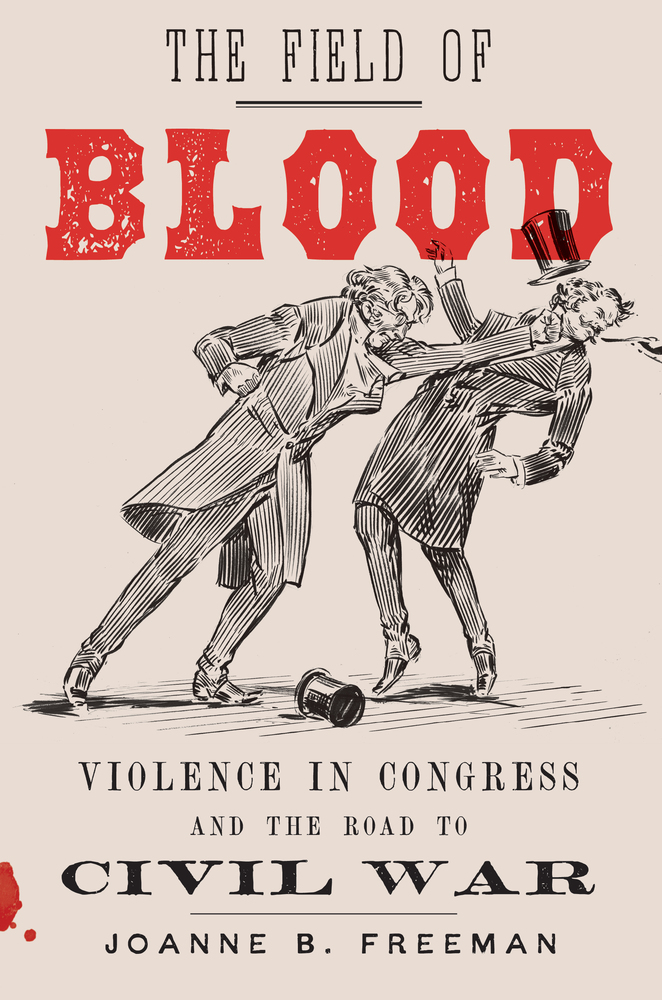
The book on violence in the antebellum Congress:


The title comes from this line, which provides the book's epigraph: In a letter to Senator Charles Sumner (MA) Rev. John Turner Sargent wrote that "blood would flow—somebody’s blood, either yours or Wilson’s, or Hale’s, or Giddings’— before the expiration of your present session on that field of blood, the floor of Congress.” 

Sargent was alluding to the burial place of Judas: "And the chief priests took the silver pieces, and said, It is not lawful for to put them into the treasury, because it is the price of blood. And they took counsel, and bought with them the potter's field, to bury strangers in. Wherefore that field was called, The field of blood, unto this day" (Matthew 27:6-8 KJV).

It was literally an atmosphere conducive to violence:
All this in a room that was hot, stuffy, and smelly. At the end of a typical day, with the galleries full and hours of body heat trapped in the chamber, [Benjamin Brown] French thought that reading aloud to members was like reading “with his head stuck into an oven.” ...  Ongoing whimpering from the floor produced another study, this one demonstrating that it was thirty degrees warmer inside than outside and that the chamber smelled of sewage from the basement. Visiting the new chamber not long after it opened, French wasn’t impressed. The idea of “shutting up a thousand or two people in a kind of cellar, where none of God’s direct light or air can come in to them . . . does not jump with my notions of living,” he groused. Thirty years later, members still declared the House “the worst ventilated building on the continent."
Professor Freeman explains how hard it was to research the violence (Start at around 9:30):


In 1856, Senator Sumner delivered his famous "Crime Against Kansas" speech. He attacked the absent Andrew Butler (SC), saying he had " a mistress . . . who, though ugly to others, is always lovely to him; though polluted in the sight of the world, is chaste in his sight—I mean," the harlot, Slavery."

Two days later, Butler's cousin, Representative Preston Brooks of South Carolina, responded:


File:Southern Chivalry.jpg - Wikimedia Commons

The Drunk History version:


You can see the cane in the Old State House in Boston:


Fast forward

Senate 1925

Senate today


Monday, January 26, 2026

Dualities


For Wednesday: Freeman reading on Canvas                                                          

Some basics:
Demographics and Descriptive representation
Home style

"What you have to understand about my people is that they are a noble people. Humility is their form of pride. It is their strength; it is their weakness. And if you can humble yourself before them they will do anything you ask." -- Frank Underwood

In Home Style, members try to convey
  • Qualification
  • Identification
  • Empathy
US Style:

AOC on Musk


Nancy Mace explains her vote against Kevin McCarthy


One major difference between the chambers is that few House members run for president, and seldom get far when they do. But a fairly large fraction of senators have gone for the White House:
  • Michael Bennet (D-CO), 2020
  • Cory Booker (D-NJ) 2020
  • Ted Cruz (R-TX) 2016
  • Kirsten Gillibrand (D-NY) 2020
  • Lindsey Graham (R-SC) 2016
  • Amy Klobuchar (D-MN) 2020
  • Rand Paul (R-KY) 2016
  • Bernard Sanders (I-VT) 2016, 2020
  • Tim Scott (R-SC) 2024
  • Elizabeth Warren (D-MA), 2020
Possible 2028 Candidates
  • Ruben Gallego (D-AZ)
  • Josh Hawley (R-MO)
  • Mark Kelly (D-AZ)
  • Ted Cruz (R-TX)
In the House, see
  • Seth Moulton (D-MA), 2020
  • Eric Swalwell (D-CA) 2020
Possibly Alexandria Ocasio-Cortez (D-NY)

Four Strategic Postures Since 2000 (House, by election year) 

                    Majority                              Minority 

In Party        Dems 08, 20                     GOP 06, 18
                    GOP 00, 02, 04, 16, 24      Dem 10,12,14,22
           
Out Party     GOP 10,12,14,22              GOP 08, 20
                    Dem 06, 18                        Dem 00, 02, 04, 16, 24

Tuesday, January 20, 2026

In the Beginning

  For Monday, read Davidson ch. 1 and 2.

Objectives of the course:
  • Why the institution operates the way it does  
  • What motivates members
    • Reelection
    • Power:  individual and party
    • Public policy
    • Attention and disruption
  • How the institution has changed in recent years
    • Polarization
    • Nationalization of elections and internal congressional politics.
  • How lawmakers, activists, and ordinary citizens accomplish their aims.
  • Dualities
    • Two Congresses: Representative assembly and lawmaking body.
    • Two chambers:  House and Senate are different.
    • Two parties:  Republicans and Democrats differ ideologically, geographically, and demographically, though the lines have shifted over the years.
    • Two kinds of status:  being in the majority is really different from being in the minority.
    • Two layers of lawmaking:  high-profile and partisan (The Public Congress), lower-profile and practical (The Shadow Congress)
  • Recent developments
    • Trump administration and executive actions
    • Narrow House majority, change of Senate control
  • Deliberation and compromise
  • Will the situation change

Tuesday, May 6, 2025

The End

 No class Thursday

Papers due tomorrow night at 11:59 pm.

Stylistic reminders
Review of the Dualities:

Two chambers: House v. Senate
Two Congresses: Policy priorities v. constituent priorities
Two parties:  GOP v. Dems

Life Lessons

Simulation?

In all bodies, those who will lead must also, in a considerable degree, follow. They must conform their propositions to the taste, talent, and disposition of those whom they wish to conduct; therefore, if an assembly is viciously or feebly composed in a very great part of it, nothing but such a supreme degree of virtue as very rarely appears in the world, and for that reason cannot enter into calculation, will prevent the men of talent disseminated through it from becoming only the expert instruments of absurd projects! If, what is the more likely event, instead of that unusual degree of virtue, they should be actuated by sinister ambition and a lust of meretricious glory, then the feeble part of the assembly, to whom at first they conform, becomes in its turn the dupe and instrument of their designs. In this political traffic, the leaders will be obliged to bow to the ignorance of their followers, and the followers to become subservient to the worst designs of their leaders.

    Mickey Edwards: "People think what they think, not what         we want them to think."

About “problems of political courage in the face of constituent pressures, and the light shed on those problems by the lives of past statesmen.’’ Three types of pressure:

  • pressure to be liked
  • pressure to be re-elected, and
  • pressure of the constituency and interest groups.
The problem is that all three considerations have a legitimate place.

In addition to the courage of your convictions, you should also have the courage of your doubts.

Sometimes, compromise takes courage.

Taft

On October 29, 1940, Congressman Lyndon Johnson happened to be in President Franklin Roosevelt’s office when FDR’s isolationist ambassador to London, Joseph Kennedy—at whom Roosevelt was furious for his freelancing and his insufficient outrage against Adolf Hitler—returned to the United States. LBJ omits the detail that as FDR invited Kennedy by telephone for dinner, he drew his finger across his throat, razor fashion. Johnson twits Roosevelt for his indifference to civil rights, contrasting that unfavorably with LBJ’s own record.
I was with President Roosevelt the day he fired Joe Kennedy. He picked up the phone and said, “Hello, Joe, are you in New York? Why don’t you come down and have a little family dinner with us tonight?” Then he hung up and said, “That son of a bitch is a traitor. He wants to sell us out.” Well, Kennedy did say Hitler was right.
Anyway, Roosevelt didn’t have any Southern molasses compassion. He didn’t get wrapped up in going to anyone’s funeral. Roosevelt never submitted one civil rights bill in twelve years. He sent Mrs. Roosevelt to their meetings in their parks, and she’d do it up good. But President Roosevelt never faced up to the problem.

Inherent limitations of Congress:

  • Except in simulation, legislation is slow. (And swift action is not necessarily smart action.)
  • In a body resting on geographic representation, parochialism is inevitable. (And it is often legitimate.)
  • A multi-member, bicameral institution will have a hard time planning.  (And planning is overrated.)


Thursday, May 1, 2025

Foreign Policy and National Security II

  • Adjourn at noon for course evals.
  • For next week, Davidson ch. 16
  • Last weekly writeups
Presidential advantages on war and peace

Hamilton in Federalist 8: "It is of the nature of war to increase the executive at the expense of the legislative authority."

Tocqueville, p. 126: "If the Union’s existence were constantly menaced, and if its great interests were continually interwoven with those of other powerful nations, one would see the prestige of the executive growing, because of what was expected from it and of what it did."

Knowledge and experience:


The Constitution and War:

To declare war, grant letters of marque and reprisal, and make rules concerning captures on land and water;
 To raise and support armies, but no appropriation of money to that use shall be for a longer term than two years;
To provide and maintain a navy;
To make rules for the government and regulation of the land and naval forces;

To provide for calling forth the militia to execute the laws of the union, suppress insurrections and repel invasions;

To provide for organizing, arming, and disciplining, the militia, and for governing such part of them as may be employed in the service of the United States, reserving to the states respectively, the appointment of the officers, and the authority of training the militia according to the discipline prescribed by Congress;
Article II, section 2:
The President shall be commander in chief of the Army and Navy of the United States, and of the militia of the several states, when called into the actual service of the United States;
CRS explains that a declaration of war has enormous legal consequences
[A] declaration of war automatically brings into effect a number of statutes that confer special powers on the President and the Executive Branch, especially concerning measures that have domestic effect. A declaration, for instance, activates statutes that empower the President to interdict all trade with the enemy, order manufacturing plants to produce armaments and seize them if they refuse, control transportation systems in order to give the military priority use, and command communications systems to give priority to the military. A declaration triggers the Alien Enemies Act, which gives the President substantial discretionary authority over nationals of an enemy state who are in the United States. It activates special authorities to use electronic surveillance for purposes of gathering foreign intelligence information without a court order under the Foreign Intelligence Surveillance Act. It automatically extends enlistments in the armed forces until the end of the war, can make the Coast Guard part of the Navy, gives the President substantial discretion over the appointment and reappointment of commanders, and allows the military priority use of the natural resources on the public lands and the continental shelf. 
There have been 11 declarations of war.


On 1/23/1941, Charles Lindbergh testified before the House Foreign Affairs Committee, calling for a negotiated peace with Hitler.  He had this exchange with Rep. Luther Johnson (D-TX):


The Gulf of Tonkin Resolution

The War Powers Resolution -- From CRS:
The War Powers Resolution (P.L. 93-148) was enacted over the veto of President Nixon on November 7, 1973, to provide procedures for Congress and the President to participate in decisions to send U.S. Armed Forces into hostilities. Section 4(a)(1) requires the President to report to Congress any introduction of U.S. forces into hostilities or imminent hostilities. When such a report is submitted or is required to be submitted, Section 5(b) requires that the use of forces must be terminated within 60 to 90 days unless Congress authorizes such use or extends the time period. Section 3 requires that the “President in every possible instance shall consult with Congress before introducing” U.S. Armed Forces into hostilities or imminent hostilities.

From 1975 through March 2017, Presidents have submitted 168 reports as the result of the War Powers Resolution, but only one, the 1975 Mayaguez seizure, cited Section 4(a)(1), which triggers the 60-day withdrawal requirement, and in this case the military action completed and U.S. armed forces had disengaged from the area of conflict when the report was made.

Reading the report 

Iraq vote in the Senate


Tuesday, April 29, 2025

Foreign Policy and National Security I

Topics for Thursday?

Please remember  your last write-ups this week.

Course evaluations at the end of next class.  Bring your devices.

On January 12, 1991, House Speaker Tom Foley (D-WA) spoke about the impending Gulf War. Click for video of their remarks, so you can see what grownups look like:


Foreign Affairs Generally


Treaties and International Agreements (Davidson 427-428)

War and Intelligence

(FY)
1962.................49.0%..........8.9%
1972.................34.3%..........6.5%
1982.................24.8%..........5.6%
1992.................21.6.............4.6%
2002.................17.3%..........3.2%
2012.................19.2%..........4.2%
2022.................12.2%..........3.1%
2023.................13.4%..........3.0%
2024.................13.1%..........3.2%


Prologue:  Steps in launching a nuclear war

Hamilton in Federalist 8: "It is of the nature of war to increase the executive at the expense of the legislative authority."

Tocqueville, p. 126: "If the Union’s existence were constantly menaced, and if its great interests were continually interwoven with those of other powerful nations, one would see the prestige of the executive growing, because of what was expected from it and of what it did."

The Constitution and War:

To declare war, grant letters of marque and reprisal, and make rules concerning captures on land and water;
 To raise and support armies, but no appropriation of money to that use shall be for a longer term than two years;
To provide and maintain a navy;
To make rules for the government and regulation of the land and naval forces;

To provide for calling forth the militia to execute the laws of the union, suppress insurrections and repel invasions;

To provide for organizing, arming, and disciplining, the militia, and for governing such part of them as may be employed in the service of the United States, reserving to the states respectively, the appointment of the officers, and the authority of training the militia according to the discipline prescribed by Congress;
Article II, section 2:
The President shall be commander in chief of the Army and Navy of the United States, and of the militia of the several states, when called into the actual service of the United States;
CRS explains that a declaration of war has enormous legal consequences
[A] declaration of war automatically brings into effect a number of statutes that confer special powers on the President and the Executive Branch, especially concerning measures that have domestic effect. A declaration, for instance, activates statutes that empower the President to interdict all trade with the enemy, order manufacturing plants to produce armaments and seize them if they refuse, control transportation systems in order to give the military priority use, and command communications systems to give priority to the military. A declaration triggers the Alien Enemy Act, which gives the President substantial discretionary authority over nationals of an enemy state who are in the United States. It activates special authorities to use electronic surveillance for purposes of gathering foreign intelligence information without a court order under the Foreign Intelligence Surveillance Act. It automatically extends enlistments in the armed forces until the end of the war, can make the Coast Guard part of the Navy, gives the President substantial discretion over the appointment and reappointment of commanders, and allows the military priority use of the natural resources on the public lands and the continental shelf. 
There have been 11 declarations of war.

Use of military force abroad (usually without a declaration of war)

The War Powers Resolution -- From CRS:
The War Powers Resolution (P.L. 93-148) was enacted over the veto of President Nixon on November 7, 1973, to provide procedures for Congress and the President to participate in decisions to send U.S. Armed Forces into hostilities. Section 4(a)(1) requires the President to report to Congress any introduction of U.S. forces into hostilities or imminent hostilities. When such a report is submitted or is required to be submitted, Section 5(b) requires that the use of forces must be terminated within 60 to 90 days unless Congress authorizes such use or extends the time period. Section 3 requires that the “President in every possible instance shall consult with Congress before introducing” U.S. Armed Forces into hostilities or imminent hostilities.

From 1975 through March 2017, Presidents have submitted 168 reports as the result of the War Powers Resolution, but only one, the 1975 Mayaguez seizure, cited Section 4(a)(1), which triggers the 60-day withdrawal requirement, and in this case the military action completed and U.S. armed forces had disengaged from the area of conflict when the report was made.


Blog Archive