Tuesday, February 16, 2021
The Ex Is Unhappy with Mitch
“The Republican Party can never again be respected or strong with political “leaders” like Sen. Mitch McConnell at its helm. McConnell’s dedication to business as usual, status quo policies, together with his lack of political insight, wisdom, skill, and personality, has rapidly driven him from Majority Leader to Minority Leader, and it will only get worse. The Democrats and Chuck Schumer play McConnell like a fiddle—they’ve never had it so good—and they want to keep it that way! We know our America First agenda is a winner, not McConnell’s Beltway First agenda or Biden’s America Last.
In 2020, I received the most votes of any sitting President in history, almost 75,000,000. Every incumbent House Republican won for the first time in decades, and we flipped 15 seats, almost costing Nancy Pelosi her job. Republicans won majorities in at least 59 of the 98 partisan legislative chambers, and the Democrats failed to flip a single legislative chamber from red to blue. And in “Mitch’s Senate,” over the last two election cycles, I single-handedly saved at least 12 Senate seats, more than eight in the 2020 cycle alone—and then came the Georgia disaster, where we should have won both U.S. Senate seats, but McConnell matched the Democrat offer of $2,000 stimulus checks with $600. How does that work? It became the Democrats’ principal advertisement, and a big winner for them it was. McConnell then put himself, one of the most unpopular politicians in the United States, into the advertisements. Many Republicans in Georgia voted Democrat, or just didn’t vote, because of their anguish at their inept Governor, Brian Kemp, Secretary of State Brad Raffensperger, and the Republican Party, for not doing its job on Election Integrity during the 2020 Presidential race.
It was a complete election disaster in Georgia, and certain other swing states. McConnell did nothing, and will never do what needs to be done in order to secure a fair and just electoral system into the future. He doesn’t have what it takes, never did, and never will.
My only regret is that McConnell “begged” for my strong support and endorsement before the great people of Kentucky in the 2020 election, and I gave it to him. He went from one point down to 20 points up, and won. How quickly he forgets. Without my endorsement, McConnell would have lost, and lost badly. Now, his numbers are lower than ever before, he is destroying the Republican side of the Senate, and in so doing, seriously hurting our Country.
Likewise, McConnell has no credibility on China because of his family’s substantial Chinese business holdings. He does nothing on this tremendous economic and military threat.
Mitch is a dour, sullen, and unsmiling political hack, and if Republican Senators are going to stay with him, they will not win again. He will never do what needs to be done, or what is right for our Country. Where necessary and appropriate, I will back primary rivals who espouse Making America Great Again and our policy of America First. We want brilliant, strong, thoughtful, and compassionate leadership.
Prior to the pandemic, we produced the greatest economy and jobs numbers in the history of our Country, and likewise, our economic recovery after Covid was the best in the world. We cut taxes and regulations, rebuilt our military, took care of our Vets, became energy independent, built the wall and stopped the massive inflow of illegals into our Country, and so much more. And now, illegals are pouring in, pipelines are being stopped, taxes will be going up, and we will no longer be energy independent.
This is a big moment for our country, and we cannot let it pass by using third rate “leaders” to dictate our future!”


Second Assignment, Spring 2021
1. Pick any bill from the 116th (2019-2020) Congress. Explain its fate. Instead of giving a mere chronology, tell why the measure moved or stalled. What happened to previous versions? Which groups or blocs backed and fought it? Did the administration take a position? Which strategies and tactics did its friends and foes use? Even if it failed or stalled, did it prompt the passage of a similar measure in a different form? Look at parliamentary strategies, major amendments, and roll calls. Again, you should explain the outcome, not just describe the process. Some possible topics:
- HR 6395 (defense authorization)
- HR 5430 (NAFTA update)
- HR 8 (background checks)
- HR 1 (political reform)
- HR 4 (elections)
- HJ Res 77 (Syria)
- HJ Res 76 (student loans)
- S.J. Res 7 (Yemen)
- SJ Res 36 (Saudi arms sales)
- SJ Res 68 (Iran war powers)
3. Pick pending legislation that has not yet passed either house. Write a memo to its prime sponsor detailing a plausible strategy for securing its passage at least in one chamber. In your answer, consider all phases of the legislative process and take account of the influence of interest groups and the administration.
Get background from a source such as CQ Magazine where you may find the partisan breakdown of roll-call votes. .
Other possible sources include:
- Statements of Administration Policy -- indications of whether POTUS will sign or veto.
- Congress.gov (http://www.congress.gov/) -- official site for bill summary and status
- GovTrack (http://www.govtrack.us/) – unofficial site for congressional information
- ProQuest Congressional (http://congressional.proquest.com/profiles/gis/search/basic/basicsearch ). -- many congressional documents including searchable Congressional Record. If your computer will not accept this URL, go through the library web page (http://library.claremont.edu). Click “databases,” then the letter “P,” then “ProQuest Congressional.”)
- Committee web pages, which usually contain testimony and text of reports. See http://www.house.gov/committees/ or https://www.senate.gov/committees/index.htm
- ProPublica tools and websites at https://projects.propublica.org/represent/
-------------------------------------------------------------------------------------------------------------------
- Essays should be typed, double-spaced, and no more than five pages long. I will not read past the fifth page.
- Cite your sources with endnotes in standard Turabian format. Endnote pages do not count against the page limit.
- Watch your spelling, grammar, diction, and punctuation. Errors will count against you. Return essays (as Word documents, not pdfs) to the Sakai dropbox by 11:59 PM, Friday, March 5. I reserve the right to dock papers will one gradepoint for one day’s lateness, a full letter grade after that.
Earmarks Making a Possible Comeback
Politico article out today quoting House Majority Leader Steny Hoyer (D-MD) as privately telling Democrats "that earmarks will be revived this Congress and that he can 'guarantee' the effort 'will be bipartisan,' according to two people on the call."
The article also mentions concerns that swing-seat Democrats have about earmarks' return being used in GOP attack ads. One Dem aide states, "We’re not going to have a majority if we bring back earmarks."
This analysis piece by Chris Cillizza at CNN also discusses some of the recent history behind earmarks, and concludes that they are necessary for a functioning Congress - "If you want bipartisanship and bills to actually pass Congress, you want earmarks to come back. It's Congress' secret sauce."
Monday, February 15, 2021
Parties and Leadership I
Hill leadership
Edmund Burke:
Member Organizations
In all bodies, those who will lead, must also, in a considerable degree, follow. They must conform their propositions to the taste, talent, and disposition, of those whom they wish to conduct: therefore, if an assembly is viciously or feebly composed in a very great part of it, nothing but such a supreme degree of virtue as very rarely appears in the world, and for that reason cannot enter into calculation, will prevent the men of talent disseminated through it from becoming only the expert instruments of absurd projects!
- Is party unity the same as party discipline? (See Staus, ch. 3)
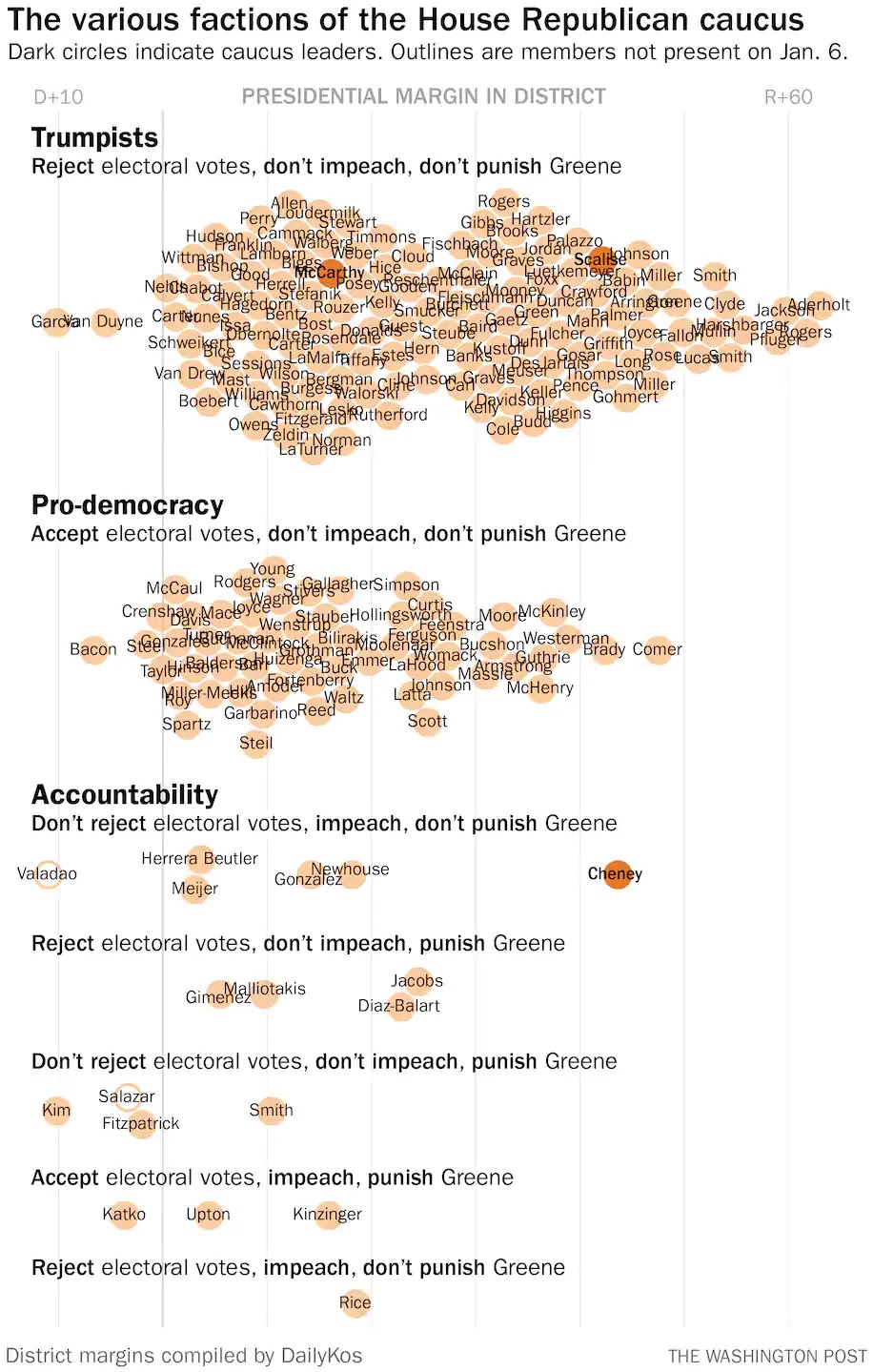
- The Cheney vote
- The role of state parties and local politics
Member Organizations
Informal Groups
- House Freedom Caucus
- The Squad
- The Force
- Role of women (Staus ch. 13)
Generations and Immigration
Immigrants and the children of immigrants account for a small but growing share of lawmakers on Capitol Hill. At least 76 (14%) of the voting members of the 117th Congress are foreign born or have at least one parent born in another country, a slight uptick from the prior two Congresses.
Overall, there are 18 foreign-born members of the 117th Congress – 17 representatives and one senator, Mazie Hirono, D-Hawaii, who was born in Japan. At least 58 other members, including 42 in the House and 16 in the Senate, were born in the United States or its territories to at least one immigrant parent, according to a Pew Research Center analysis of biographical information from the Congressional Research Service, news stories and members’ official websites and genealogical records through Feb. 8.

The number of Millennials and Generation Xers in the U.S. House of Representatives rose slightly with the new 117th Congress, though less so than with the 116th. And even as these generations gain representation in both chambers, older generations still make up the majority of senators and representatives.

Thursday, February 11, 2021
Followups to Yesterday's Discussion of Elections
Democrats face a daunting future of severe Republican gerrymandering that could flip control of the House in 2022 and suppress diverse younger generations’ political influence for years to come, according to a new study released today. Those findings underscore the stakes in Democrats’ efforts to pass national legislation combatting such electoral manipulation.
The four big states to watch are Texas, Florida, Georgia, and North Carolina, where the GOP enjoys complete control over the redistricting process, says Michael Li, a senior counsel at the Brennan Center for Justice and the author of the new report on how congressional redistricting could unfold following the 2020 census. “Those four states, which are seat-rich and where Republicans control the process, could decide who controls the next Congress,” he told me.
Over the longer term, Republican states could impose gerrymanders that prevent the nation’s growing nonwhite population from building political power commensurate with its numbers—even though voters of color accounted for about four in five newly eligible voters in the past decade, the study found.
The report, which was provided exclusively to The Atlantic, comes as Democrats prepare to advance two bills to guarantee voting rights and reshape the rules regarding federal elections: a new Voting Rights Act and the omnibus legislation called H.R. 1. Both bills, which the Democratic-controlled House approved in the previous session, are likely to pass the chamber again this year—with H.R. 1 potentially winning approval as soon as early next month, House aides say. But both are virtually certain to be blocked in the Senate by a Republican filibuster—unless Democrats change the upper chamber’s rules to allow them to pass with a simple-majority vote.
Wednesday, February 10, 2021
Home Style and Hill Style
In Home Style, members try to convey
- Qualification
- Identification
- Empathy
FOUR WAYS OF BEING A MEMBER:
- DISTRICT (OR STATE) SERVANTS
- COMMITTEE SPECIALISTS
- PARTY LEADERS
- NATIONAL POLITICAL FIGURES
Subscribe to:
Posts (Atom)