Republicans are looking for people with no political experience to run on the "anti establishment" wave.
If you are still looking for a paper topic there are some names in here you might consider...
http://online.wsj.com/article/SB10001424052748703894304575047241446787622.html?mod=WSJ_WSJ_US_News_5
Saturday, February 6, 2010


Friday, February 5, 2010
Demographics and Congressional Elections
There is an important new National Journal article that we shall discuss on Monday. See excerpt below. For full text, click here.
Generally, the greater the district's nonwhite population and the higher the education level of its white residents, the more likely it is to be represented in the House by a Democrat. In contrast, the analysis found, the whiter the district and the lower its number of white college graduates, the more likely it is to elect a Republican...
In the struggle for House control, the two parties thus face tests with contrasting timeframes. As racial minorities and better-educated whites, or both, become a larger share of the population in more districts, the long-run challenge for Republicans is to compete across a demographically broader range of districts than they do now. Democrats face a more immediate trial: Avoiding a repeat of the huge wave, particularly among working-class whites, that carried Republicans to control of the House in 1994. The increase in the number of high-minority and well-educated districts provides House Democrats defenses that they lacked back then. But if the tide of white working-class discontent reaches high enough or spills over to include enough upscale white voters, even those levees may not protect the House majority that Democrats labored so long to recapture.
(Note that the research associate for this article is Cameron Joseph, CMC `08, who wrote his senior thesis on the South and the GOP.)
Demonsheep Update
From the San Jose Mercury News:
If all press is good press, Carly Fiorina's bizarre campaign video depicting her opponent as a red-eyed demon sheep is a blockbuster hit.
If widespread mockery matters, the joke may be on Fiorina.
Whatever the case, the former Hewlett-Packard CEO's 31/2-minute Web video attacking Tom Campbell in the Republican Senate primary has gone viral, drawing more than 191,949 views on YouTube, rising to the top of Twitter topics and spurring commentary on dozens of political news sites
The Demonsheep ad has inspired yet another YouTube remix of Der Untergang:
Wednesday, February 3, 2010
Demand Question Time
A politically diverse group of bloggers, commentators, techies and politicos on Wednesday will launch an online campaign urging the President to hold more question time like sessions with Congress.
The group's website, DemandQuestionTime.com, launched this morning and as of the writing of this post has 2571 petition signatures.
A few interesting things: perhaps this could save the President's agenda. Nate Silver, who runs 538, has done considerable analysis on the Democratic Party's messaging strategy particularly as it pertains to health care. He argues that public opinion is souring, at least in part, because the public doesn't know what's in the bill. He creates a nice table:

The President, at his question time with House Republicans in Baltimore, told the GOP to stop crying "Commie" and instead look at the actual legislation, hoping to shrink the gap between the rhetoric and the reality. However, as long as the pinko message is working, it's hard to imagine why the GOP would.
But question time could bring a new age of political discourse, where the President can use his personal touch and debating skill to rewarm the public. Rather than have each side spout talking points, you could have a legitimate debate (was anyone else super excited when the West Wing did the Santos/Vinick "real" debate)?
This could help members of Congress. Nobody watches floor speeches or committee debates, and I'm certain few would watch Presidential question time. But certainly more would, and face time with the President, arguing the merits or follies of policy, would increase visibility. Imagine if after "you lie" the President and Rep. Wilson had a brief chat about covering illegals. It would have boosted the President's bipartisan and personal credentials while elevating Rep. Wilson to equal footing with POTUS. It also might have cleared up confusion about the President's policies.
The Demand Question Time folks say it best:
At the conclusion of my writing, the website has 2683 "signatures." Oh, the age of Web 2.0.
The group's website, DemandQuestionTime.com, launched this morning and as of the writing of this post has 2571 petition signatures.
A few interesting things: perhaps this could save the President's agenda. Nate Silver, who runs 538, has done considerable analysis on the Democratic Party's messaging strategy particularly as it pertains to health care. He argues that public opinion is souring, at least in part, because the public doesn't know what's in the bill. He creates a nice table:
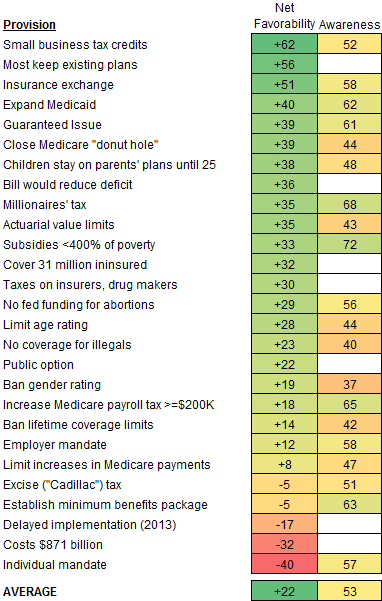
The President, at his question time with House Republicans in Baltimore, told the GOP to stop crying "Commie" and instead look at the actual legislation, hoping to shrink the gap between the rhetoric and the reality. However, as long as the pinko message is working, it's hard to imagine why the GOP would.
But question time could bring a new age of political discourse, where the President can use his personal touch and debating skill to rewarm the public. Rather than have each side spout talking points, you could have a legitimate debate (was anyone else super excited when the West Wing did the Santos/Vinick "real" debate)?
This could help members of Congress. Nobody watches floor speeches or committee debates, and I'm certain few would watch Presidential question time. But certainly more would, and face time with the President, arguing the merits or follies of policy, would increase visibility. Imagine if after "you lie" the President and Rep. Wilson had a brief chat about covering illegals. It would have boosted the President's bipartisan and personal credentials while elevating Rep. Wilson to equal footing with POTUS. It also might have cleared up confusion about the President's policies.
The Demand Question Time folks say it best:
We live in a world that increasingly demands more dialogue than monologue.
At the conclusion of my writing, the website has 2683 "signatures." Oh, the age of Web 2.0.
Tuesday, February 2, 2010
Updated Information on Parties
Gallup has new data on state-level party identification:
In total, 23 states plus the District of Columbia can be classified as solidly Democratic, with a 10 percentage-point or greater advantage in party affiliation in favor of the Democrats. This includes most of the Northeast and mid-Atlantic regions, most of the Great Lakes region, and the Pacific Coast.
Another 10 states can be considered Democratic leaning, in which the state's Democratic supporters outnumber Republican supporters by at least 5 percentage points but less than 10 points. These are Missouri, Kentucky, North Carolina, Florida, New Hampshire, Virginia, Colorado, Nevada, Indiana, and Tennessee.
Four states are solidly Republican, with a better than 10-point advantage in Republican affiliation -- Wyoming, Utah, Alaska, and Idaho. Alabama qualifies as the lone Republican-leaning state, with a 6-point advantage in Republican affiliation.
That leaves 12 states that are competitive, with less than a 5-point advantage for either party. Among these 13 states, 6 tilt in a Republican direction: Montana, Nebraska, Mississippi, Texas, North Dakota, and Kansas. Six tilt toward the Democratic Party: Georgia, South Dakota, Louisiana, Arizona, Oklahoma, and South Carolina.
Monday, February 1, 2010
A late post, but the imagery in the Republican response to this year's SOTU was too fun to ignore. McDonnell addressed a group in the Virginia Capitol to create the illusion of speaking before Congress. That those gathered are almost entirely McDonnell supporters gives an amusing rally-like vibe in an event posing as a serious attempt at statesmanship.
Subscribe to:
Posts (Atom)