ABOUT THIS BLOG

I shall post videos, graphs, news stories, and other material there. We shall use some of this material in class, and you may review the rest at your convenience. You will all receive invitations to post to the blog. (Please let me know if you do not get such an invitation.) I encourage you to use the blog in these ways:
To post questions or comments about the readings before we discuss them in class;
To follow up on class discussions with additional comments or questions.
To post relevant news items or videos.

There are only two major limitations: no coarse language, and no derogatory comments about people at the Claremont Colleges.


Search This Blog

Tuesday, January 27, 2026

Congressional History

 For next Monday, Davidson, ch. 3 and 4.

If you have not already done a writeup: Find one sentence in Chapter 2 you disagreed with. Quote it and explain why it does not fit how you think members of Congress actually behave today.  If you cannot find one with which you disagree, find one that an ideologue of the left or right would dispute.

Institutional Evolution:

  • Bicameralism and House-Senate differences: impact of 17th Amendment.
  • Size of the House and Senate (more below)
  • Congressional Career and professionalism
    • Staff
    • Rules and Institutional Structure

"All of American history comes from the Civil War. It is the most important event in our history. Everything before it led up to it, everything since, everything, is a consequence of it." -- Ken Burns

"The past is never dead. It's not even past." -- William Faulkner

Akhil Amar on the Three-Fifths Clause:

The radical vice of Article I as drafted and ratified was that it gave slaveholding regions extra clout in every election as far as the eye could see - a political gift that kept giving. And growing. Unconstrained by any explicit intrastate equality norm in Article I, and emboldened by the federal [3/5] ratio, many slave states in the antebellum era skewed their congressional-district maps in favor of slaveholding regions within the state. Thus the House not only leaned south, but also within coastal slave states bent east, toward tidewater plantations that grabbed more than their fair share of seats. ... The very foundation of the Constitution’s first branch was tilted and rotten.
And not just the first branch. The Article II electoral college sat atop the Article I base: The electors who picked the president would be apportioned according to the number of seats a state had in the House and Senate. In turn, presidents would nominate cabinet heads, Supreme Court justices, and other Article III judges.

John Quincy Adams


The relevant constitutional provision is Article 4, section 3:
New States may be admitted by the Congress into this Union; but no new States shall be formed or erected within the jurisdiction of any other State; nor any State be formed by the Junction of two or more States, or parts of States, without the Consent of the Legislatures of the States concerned as well as of the Congress
That’s right. All it takes to create a new state is the passage of a federal law. Right now, assuming they were willing to use the nuclear option to abolish the filibuster for state admissions, any unified government could make Puerto Rico or DC a state, or (with the consent of the state leg) divide Texas (or Wyoming) into any number of states. With just a law. Irreversibly. And the constitution puts no population or land size constraints on the process either.
These three features of the statehood process—irreversibility, a low threshold for creation, and no population/size constraints on the creation of a state—made the statehood process incredibly destabilzing in the 19th century. Any majority, at any time, could rearrange the balance of power in the legislature and the electoral college. And it unambiguously exacerbated the slave crisis: so many of the major flashpoints over slavery between 1820 and 1860 involved the flawed statehood process: the Missouri Compromise, the Compromise of 1850, the Kansas-Nebraska Act, the Lecompton Constitution fight, even the Dred Scott decision. 

The book on violence in the antebellum Congress:
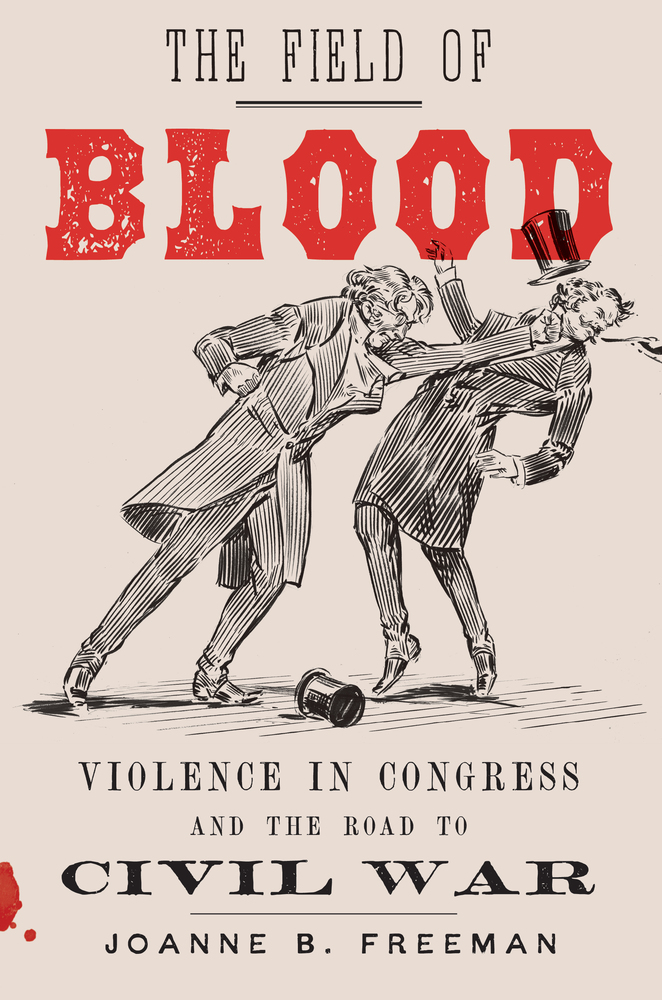


The title comes from this line, which provides the book's epigraph: In a letter to Senator Charles Sumner (MA) Rev. John Turner Sargent wrote that "blood would flow—somebody’s blood, either yours or Wilson’s, or Hale’s, or Giddings’— before the expiration of your present session on that field of blood, the floor of Congress.” 

Sargent was alluding to the burial place of Judas: "And the chief priests took the silver pieces, and said, It is not lawful for to put them into the treasury, because it is the price of blood. And they took counsel, and bought with them the potter's field, to bury strangers in. Wherefore that field was called, The field of blood, unto this day" (Matthew 27:6-8 KJV).

It was literally an atmosphere conducive to violence:
All this in a room that was hot, stuffy, and smelly. At the end of a typical day, with the galleries full and hours of body heat trapped in the chamber, [Benjamin Brown] French thought that reading aloud to members was like reading “with his head stuck into an oven.” ...  Ongoing whimpering from the floor produced another study, this one demonstrating that it was thirty degrees warmer inside than outside and that the chamber smelled of sewage from the basement. Visiting the new chamber not long after it opened, French wasn’t impressed. The idea of “shutting up a thousand or two people in a kind of cellar, where none of God’s direct light or air can come in to them . . . does not jump with my notions of living,” he groused. Thirty years later, members still declared the House “the worst ventilated building on the continent."
Professor Freeman explains how hard it was to research the violence (Start at around 9:30):


In 1856, Senator Sumner delivered his famous "Crime Against Kansas" speech. He attacked the absent Andrew Butler (SC), saying he had " a mistress . . . who, though ugly to others, is always lovely to him; though polluted in the sight of the world, is chaste in his sight—I mean," the harlot, Slavery."

Two days later, Butler's cousin, Representative Preston Brooks of South Carolina, responded:


File:Southern Chivalry.jpg - Wikimedia Commons

The Drunk History version:


You can see the cane in the Old State House in Boston:


Fast forward

Senate 1925

Senate today


Monday, January 26, 2026

Dualities


For Wednesday: Freeman reading on Canvas                                                          

Some basics:
Demographics and Descriptive representation
Home style

"What you have to understand about my people is that they are a noble people. Humility is their form of pride. It is their strength; it is their weakness. And if you can humble yourself before them they will do anything you ask." -- Frank Underwood

In Home Style, members try to convey
  • Qualification
  • Identification
  • Empathy
US Style:

AOC on Musk


Nancy Mace explains her vote against Kevin McCarthy


One major difference between the chambers is that few House members run for president, and seldom get far when they do. But a fairly large fraction of senators have gone for the White House:
  • Michael Bennet (D-CO), 2020
  • Cory Booker (D-NJ) 2020
  • Ted Cruz (R-TX) 2016
  • Kirsten Gillibrand (D-NY) 2020
  • Lindsey Graham (R-SC) 2016
  • Amy Klobuchar (D-MN) 2020
  • Rand Paul (R-KY) 2016
  • Bernard Sanders (I-VT) 2016, 2020
  • Tim Scott (R-SC) 2024
  • Elizabeth Warren (D-MA), 2020
Possible 2028 Candidates
  • Ruben Gallego (D-AZ)
  • Josh Hawley (R-MO)
  • Mark Kelly (D-AZ)
  • Ted Cruz (R-TX)
In the House, see
  • Seth Moulton (D-MA), 2020
  • Eric Swalwell (D-CA) 2020
Possibly Alexandria Ocasio-Cortez (D-NY)

Four Strategic Postures Since 2000 (House, by election year) 

                    Majority                              Minority 

In Party        Dems 08, 20                     GOP 06, 18
                    GOP 00, 02, 04, 16, 24      Dem 10,12,14,22
           
Out Party     GOP 10,12,14,22              GOP 08, 20
                    Dem 06, 18                        Dem 00, 02, 04, 16, 24

Tuesday, January 20, 2026

In the Beginning

  For Monday, read Davidson ch. 1 and 2.

Objectives of the course:
  • Why the institution operates the way it does  
  • What motivates members
    • Reelection
    • Power:  individual and party
    • Public policy
    • Attention and disruption
  • How the institution has changed in recent years
    • Polarization
    • Nationalization of elections and internal congressional politics.
  • How lawmakers, activists, and ordinary citizens accomplish their aims.
  • Dualities
    • Two Congresses: Representative assembly and lawmaking body.
    • Two chambers:  House and Senate are different.
    • Two parties:  Republicans and Democrats differ ideologically, geographically, and demographically, though the lines have shifted over the years.
    • Two kinds of status:  being in the majority is really different from being in the minority.
    • Two layers of lawmaking:  high-profile and partisan (The Public Congress), lower-profile and practical (The Shadow Congress)
  • Recent developments
    • Trump administration and executive actions
    • Narrow House majority, change of Senate control
  • Deliberation and compromise
  • Will the situation change

Friday, January 16, 2026

Gov 101 Syllabus, Spring 2026


US Congress
CMC Government 101 Spring 2026
Monday and Wednesday 9:35-10:50 PM
Roberts North 15

DRAFT: SUBJECT TO CHANGE


J.J. Pitney
Office: Kravis 232
Student Hours: Mon, Wed 1-2 PM (and whenever my door is open and I am not looking grumpy)
and by appointment

General

Woodrow Wilson wrote
 that Congress is “hard to see satisfactorily and appreciatively at a single view.” It is crowded, noisy, rule-bound, and full of competing ambitions. That complexity is exactly why Congress matters, and why it can be hard to understand.

In this course, we will make Congress easier to understand. We will break it down piece by piece and ask how lawmakers behave back home with constituents, inside the maze of Capitol Hill, and on the national stage. We will examine congressional rules, committees, parties, and incentives, not as abstractions but as forces that determine real outcomes: Why do some bills become law while others quietly die? Who really has power, when, and why?

By the end of the course, you should be able to read congressional news with a trained eye and understand what is going on beneath the headlines.

Classes

Class meetings combine lecture and discussion. Come prepared: you should complete each week’s readings before class, since discussion will assume familiarity with them. We will also regularly analyze breaking news from Congress, so you should follow at least one good daily news source such as Politico or Axios.

Blog

Our class blog is at http://gov101.blogspot.com. I will post videos, graphs, news stories, and supplemental material there throughout the semester. Some of this content will come up in class; the rest is there to deepen your understanding at your own pace.

You will receive an invitation to post on the blog (let me know if you don’t). I encourage you to use it to:

  • Raise questions or comments about the readings before we discuss them in class;
  • Extend or challenge points from class discussions;
  • Share relevant news stories, data, or videos about Congress

Think of the blog as an extension of the classroom.

Grades

Your course grade will have these components:

  • Two three-page papers: 15% each
  • One five-page paper: 25%
  • Simulation and write-up: 30%
  • Participation (class and blog): 15%

The papers will develop your research, analytical, and writing skills. Writing quality matters.  In grading and commenting, I will apply the principles of Strunk and White’s Elements of Style. If you object, you should not take this course -- or any other course I teach.

In addition to the assigned readings, I may distribute short attachments or web links that address current events or supply background information. Your papers may draw on and analyze this material.

Participation includes both in-class and online engagement. I will call on students at random. Frequent absences or lack of preparation will affect your grade. The goal is not to catch you unprepared, but to help you develop the ability to think clearly and respond effectively under pressure—a skill that matters far beyond college.

Finally, by Thursday of each week, you will email me a brief reflection (no more than 250 words) responding to the readings and class discussions. These reflections will help you process the material and develop your own analytical voice.

Details
Required Book
  • Roger H. Davidson, et al, Congress and Its Members, 20th ed. (Sage/CQ Press, 2026).
The schedule is subject to change, with advance notice.

Jan 21: Introduction

"[A]fter 11 years as a legislator, I have grown tired of the increasing incivility and plain nastiness that are now common from some elements of our American community — behavior that, too often, our political leaders exhibit themselves ... Additionally, recent incidents of political violence have made me reassess the frequent threats against me and my family. " -- Rep. Jared Golden (D-ME)


Jan 26, 28: Congressional History

"As a representative institution, the U.S. Congress embodies the temper of its time. When the nation is polarized and civic commonality dwindles, Congress reflects that image back to the American people.” -- Joanne Freeman

How does today's Congress compare with that of the past? Have lawmakers gotten better or worse? What happened on January 6, 2021?
  • Davidson, ch. 1-2 
  • Excerpts from Joanne B. Freeman (PO `84), The Field of Blood: Violence in Congress and the Road to Civil War (New York: Farrar, Straus and Giroux, 2018). ON CANVAS

Feb 2, 4: Congressional Elections, Hill Style, Home Style and US Style

In a 2021 release, Rep. Nancy Mace (R-SC) condemned "pork-barrel projects for specific Members of Congress."  In a 2026 post on X, she wrote: " MACE WIN: We wrote a congressional letter of support helping Peculiar Pigs Farm secure a $250,000 USDA Value-Added Producer Grant."

How do congressional candidates emerge onto the scene? What accounts for the party balance in the House and Senate? How do incumbents hold their seats? How do members present themselves to colleagues, constituents, and the national public?
  • Davidson, ch. 3, 4, 5.
THREE-PAGE PAPER ASSIGNED BY FEB 2,
DUE IN CANVAS BY FEB 13.

Feb 9, 11: Parties and Leadership

“If there’s a secret ballot, Mr. President,” Mr. Schumer said, “my guess is you at most get five yeses.”
“Really?” Mr. Biden responded.
“I know my caucus,” Mr. Schumer told him. “You know I know my caucus.”
Mr. Biden nodded.

How do leaders and followers influence each other on Capitol Hill? 
  • Davidson, ch. 6.
  • John Boehner, On the House (New York: St. Martin's, 2021), excerpt. ON CANVAS
Feb 16, 18: Process 

“If I let you write the substance and you let me write the procedure, I’ll screw you every time.” -- Rep. John Dingell

Who writes the bills, and how? What is the role of congressional committees?
  • Davidson ch. 7-8.

FIVE-PAGE PAPER ASSIGNED BY FEB 16, 
DUE IN CANVAS MAR 6.

Feb 23, 25: Process, Interest Groups, and Decision Making   

"If procuring votes with offers of employment is what you intend, I’ll fetch a friend from Albany who can supply the skulking men gifted at this kind of shady work. Spare me the indignity of actually speaking to Democrats. Spare you the exposure and liability." -- William Seward (David Strathairn) in Lincoln

How do members decide how to vote? What is the relative influence of leadership, constituency, and ideology? How the "outside game" of media politics complement the "inside game" of legislative maneuvering? 
  • Davidson, ch. 9, 13.

March 2, 4: The Art of the Political Deal

“`Bipartisan work is as basic as the American covenant, E pluribus unum, out of many, one,' Sen. Raphael Warnock, a Georgia Democrat, said recently on NBC’s Meet the Press. In 2022, he ran a memorable campaign ad about his unlikely work with conservative Texas Sen. Ted Cruz on an interstate highway extension connecting military communities in their states. His tagline: `I’ll work with anyone if it means helping Georgia.'" -- Jill Lawrence

How do lawmakers engage in deliberation and bargaining?
March 9, 11: Congress and the President

“If Donald Trump says, ‘jump three feet high and scratch your head,’ we all jump three feet high and scratch our head."  -- Rep.  Troy Nehls (R-TX)

How do the executive and legislative branches check each other? Do they intrude on each other's legitimate authority? Does unified government erode checks and balances?
  • Davidson, ch. 10.

March 16, 18: Spring Break

March 23, 25, 30, April 1: Legislative Simulation 

"There have been so many moments now in my various political jobs post-CMC where I've said, `Ah, this is just like simulation,' and my colleagues will look at me with very confused looks." -- Byron Koay `06

The simulation will take place both during class time (live) and possibly at other times (via Zoom).  Participants will decide on non-class times.

SIMULATION WRITEUP DUE IN CANVAS 
 BY FRIDAY, APRIL 10

Apr  6, 8: Congress and the Bureaucracy

“It would appear that some nominees haven’t been vetted, and … somebody says, ‘Go with them anyways.'”  -- Sen. John Kennedy (R-LA) 

How does Congress try to control the bureaucracy?  How do the branches battle for control of information? 
  • Davidson, ch. 11

Apr 13, 15: Courts, Impeachment, and Congressional Ethics

"U.S. Rep. Adam Schiff’s Senate campaign said Wednesday that the California Democrat had raised $8.1 million over the past three months, a period that includes his recent censure by the Republican-led House." -- Michael Blood, AP

How does Congress try to influence the composition of the judiciary?  Why have impeachment and censure lost their symbolic power? 
  • Davidson, ch. 12 
  • Readings on congressional disciplinary action.
Apr 20, 22: Budgets and Domestic Policy

"Representative Dave Min (CA-47), member of the House Oversight Committee, introduced the Bolstering America’s Democracy and Demanding Oversight and Government Ethics Act or the BAD DOGE Act."

What is domestic policy? How does Congress handle issues such as employment and health care?
  • Davidson, ch. 14.
  • Readings on current domestic issues, TBA.

THREE-PAGE PAPER ASSIGNED BY APR 22, 
DUE IN CANVAS BY MAY 6.

Apr 27, 29: National Security and the Two Congresses

"Dear members of the Congress, representatives of both parties who also visited Kyiv, esteemed congressmen and senators from both parties who will visit Ukraine, I am sure, in the future; dear representatives of diaspora, present in this chamber, and spread across the country; dear journalists, it’s a great honor for me to be at the U.S. Congress and speak to you and all Americans."  -- President Volodymyr Zelensky

Can Congress effectively check the executive branch in wartime? Do lawmakers have the expertise and information to make decisions about national and homeland security?
  • Davidson, ch. 15
  • Readings on current foreign policy issues, TBA.
May 4, 6: Reconsiderations

"My community service will be to clean up Congress of it’s [sic] corrupt frauds in a Bipartisan way." -- Expelled Rep. George Santos

How are the two Congresses faring in 2025?
  • Davidson, ch. 16.

Blog Archive